

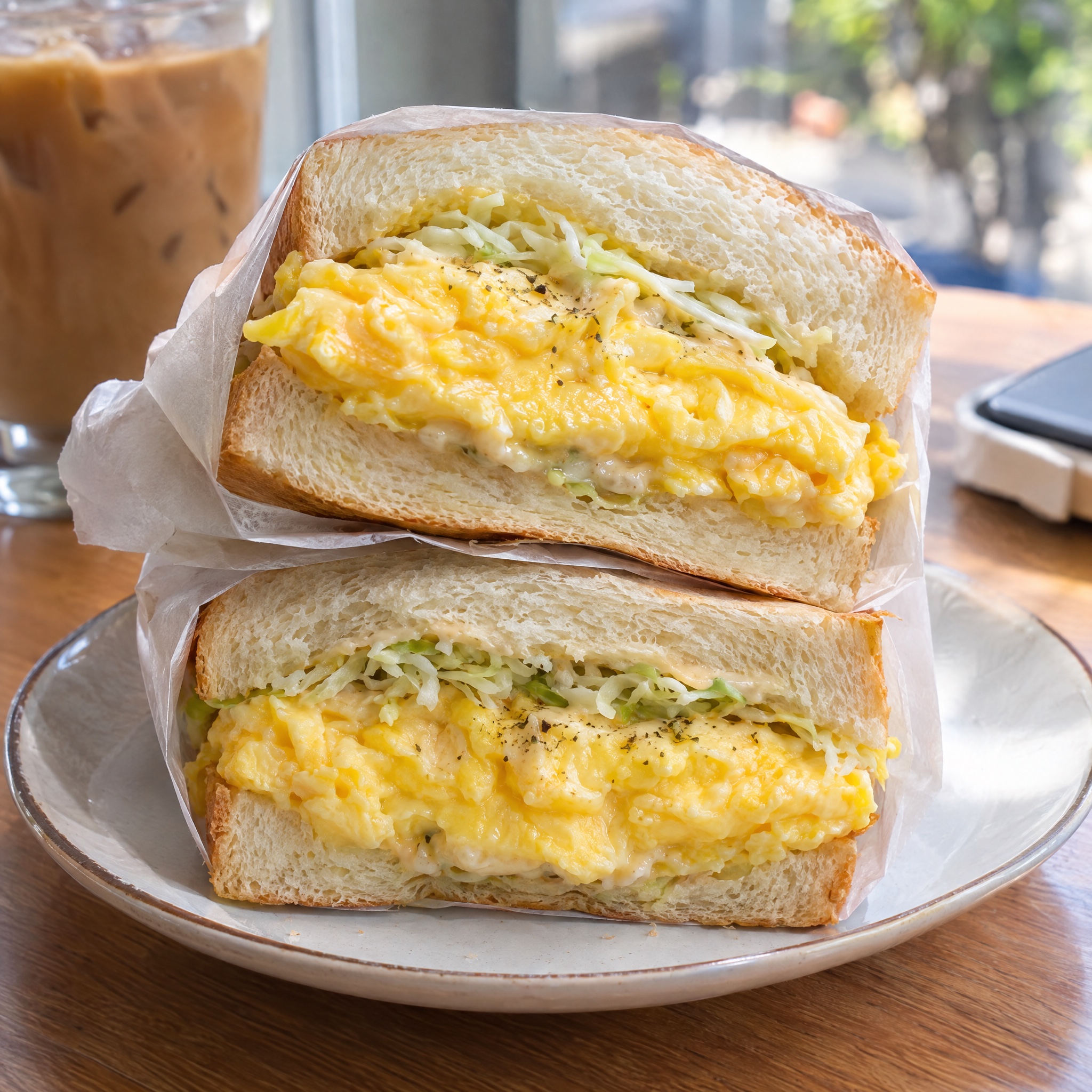
Korean egg drop sandwich
에그드롭 샌드위치
Cloud-soft scrambled egg on milk bread — the Korean café sandwich that travelled on every commuter's phone.
Recipe by I Want Some Food · Reviewed by the editorial kitchen. Native name preserved: 에그드롭 샌드위치.
0 people cooked this in the public kitchen yet. Kitchen-tested by I Want Some Food. Not a purchased rating.
- Prep
- 10 min
- Cook
- 8 min
- Rest
- None
- Total
- 18 min
- Difficulty
- Easy
- Spice
- No chilli
- Cost
- Cheap nightUnder $8 USD · indicative, not a store price
About
The Korean egg-drop sandwich is milky, barely-set scrambled eggs piled on soft white bread, often with a sweet-savoury sauce, cheese, and ham or bacon. Egg Drop the chain made a brand of it; home cooks already knew soft eggs. This is the café stack without the queue. Whisk eggs with a little milk or cream and cook them slowly into barely-set curds, milky rather than browned. Pile them on very soft white bread with a slice of cheese and, if you want the café stack, ham or bacon and a sweet-savoury sauce of ketchup, mayonnaise and sugar. Trim the crusts if you are copying the shop. This is the café sandwich without the queue. It is not a royal Korean court dish and not kimbap. It is a soft, slightly sweet breakfast sandwich with diner DNA. Serve at once while the egg still slumps. If you overcook the eggs, you have a different, still edible sandwich. Butter the bread lightly. Eat with both hands. It drips. Diner clothes, Seoul café stack. Both are the point.
Ingredients
- Egg4 large
- Milk40 ml
- Bread, soft milk bread4 slice
- Butter15 g
- Mayonnaise30 ml
- Honey4.9 ml
- Melting cheese (optional)2 slice
- Salt1.2 ml
Scaling multiplies the written quantities. Baking still prefers a scale.
Steps
Step 1
Beat eggs with milk and salt. Cook in butter over very low heat, stirring, until just set and glossy.
6 minStep 2
Mix mayo and honey. Toast bread lightly. Sauce, eggs, optional cheese.
4 minStep 3
Close, slice. Eat before the cloud weeps.
Adapt this recipe
The canonical recipe stays intact. Personal versions are labelled. Serving changes are maths, not AI.
Adaptations · 0 / 15 used. Resets 10 October.
Substitutions
Honey-mayo → Ketchup-mayo
The other café sauce.
Tips
- A double boiler makes the eggs idiot-proof.
- Cabbage shreds are a chain extra for crunch.
History & culture
Seoul and campus cafés, then every food court. Related to tamago sando, louder on sauce. Campus queues and boxed office stacks made a shop breakfast into a Seoul habit, then a food-court export. It is cousin to a Japanese tamago sando, louder on sauce and often hotter on cheese. At home it is a slightly fussy scramble plus supermarket bread, which is enough. It is not juk, not kimchi, not a court breakfast. Café Korea is a real way cities eat now. Sweet sauce bothers purists and delights the people the shops were built for. Skip the sugar if the sweetness bothers you; make the shop version if that is the treat you wanted. Both are honest. Iced coffee is the usual partner. It is a snack as much as a meal. It drips. That is the point.
A 2010s Korean café product with American diner DNA. Viral because the egg looks like a cloud. Chains standardised the sauce and the trim. That is commercial history, quite recent, and still Korean in the sense that Seoul cafés made it a named thing people fly for. It does not need to be Joseon. Modern East Asian café food is allowed on a Korean page if we say what it is. Cooking it at home is covering a shop. Soft eggs on white bread are older than the brand in several countries; the particular sweet stack is the Korean café chapter. Keep the adjectives: milky, soft, recent, shop-born. Then eat. Café chains and campus queues are the primary sources. Treat them as such, then scramble the eggs softly. Seoul cafés in the 2010s standardised a milky scramble on trimmed white bread with a sweet sauce, borrowing diner eggs and a sando silhouette. Chains did the branding. Soft eggs on bread are older in several countries; this particular stack is a Korean shop chapter. It does not need a Joseon costume. Then eat it before it cools.
Modern adaptation
Provenance: Editorial adaptation.
Questions about this recipe
Answers taken from this dish's times, amounts, swaps and tips — not a chatbot.
How long does Korean egg drop sandwich take?
18 min all in — 10 min prep, 8 min cook. Cook and rest follow the method. Leftover storage and optional extra waits are not included.
How many does it serve?
The recipe is written for 2 sandwiches. Scale the ingredient list on the page if you are cooking for a different number.
How hard is it?
Easy.
How spicy is it?
No chilli.
What allergens should I watch?
This recipe is labelled for Eggs, Wheat, Milk. Labels are informational — check the packets in your kitchen. This is not medical advice.
Does it fit a diet?
The published recipe is labelled Vegetarian, Nut-free.
What does it cost to cook?
Cheap night — about Under $8 USD, as a grocery budget for this recipe, not a restaurant price.
What equipment do I need?
Saucepan, Frying pan.
How much salt do I put in?
The recipe lists Salt at ¼ tsp.
How much honey?
1 tsp of Honey.
What can I use instead?
Honey-mayo → Ketchup-mayo. The other café sauce.
Any tips from this recipe?
A double boiler makes the eggs idiot-proof. Cabbage shreds are a chain extra for crunch.
Can I use an air fryer?
This method is not written for an air fryer. The core technique on the page still applies.
Similar dishes
Checking your allergy settings…