


Ceviche
Ceviche
Peruvian lime-cured fish with chilli, red onion and coriander. Your fishmonger matters more than your knife skills.
Recipe by I Want Some Food · Reviewed by the editorial kitchen. Native name preserved: Ceviche.
0 people cooked this in the public kitchen yet. Kitchen-tested by I Want Some Food. Not a purchased rating.
- Prep
- 25 min
- Cook
- 15 min
- Rest
- None
- Total
- 40 min
- Difficulty
- Medium
- Spice
- Medium heat
- Cost
- A bit special$16–28 USD · indicative, not a store price
About
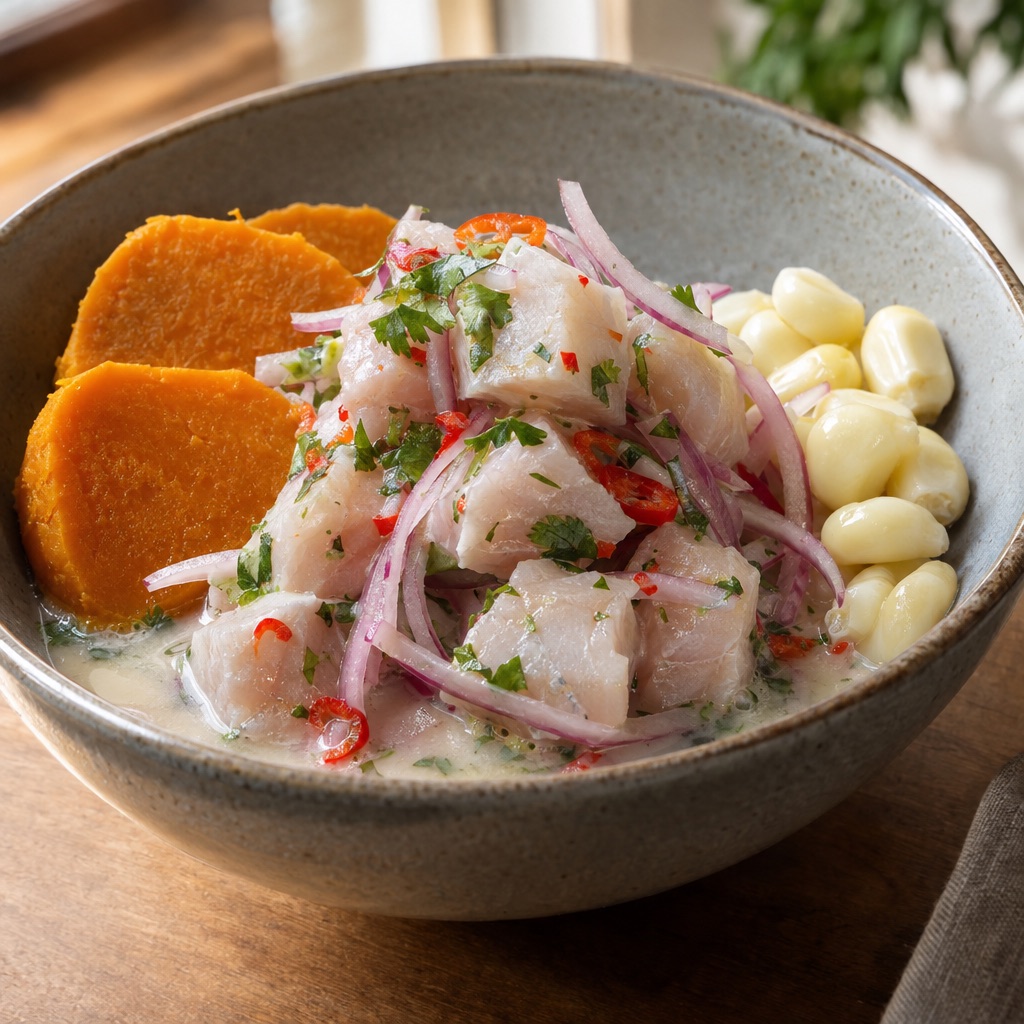
Ceviche is acid, chilli, onion and very fresh fish. The lime 'cooks' the surface; the centre stays tender if you do not drown it for an hour. Classic Lima style (ceviche limeño) is short-cured, served with sweet potato and corn. This is not a dump-and-wait leftover salad. If you cannot get fish you would eat raw, make something else tonight. Buy fish you would eat raw the same morning; if the slab smells more than the sea, cook something else. Salt the dice first, then dress with fresh lime — bottled juice tastes flat. Keep the cure short so the centre stays tender. Done is opaque edges, a still-translucent middle, and onion that has lost its raw fight without going limp; sweet potato and corn on the side are texture, not garnish theatre.
Ingredients
- Firm white fish, sushi-quality, skinned, cubed500 g
- Lime, juiced just before mixing8
- Red onion, very thinly sliced, rinsed in cold water1 small
- Fresh chilli, seeded if you want less heat, finely chopped1
- Coriander, chopped1 handful
- Sweet potato, boiled until just tender, sliced400 g
- Corn, boiled200 g
- Salt4.9 ml
- Ginger, tiny grate, optional5 g
Scaling multiplies the written quantities. Baking still prefers a scale.
Steps
Step 1
Boil sweet potato and corn. Cool. Cube the fish and keep it cold.
15 minWatch: Use fish you would eat raw. When unsure, skip this recipe.
Step 2
Salt the fish. Add chilli, a tiny bit of ginger if using, and most of the onion. Pour over lime juice and toss. The fish should sit 5–10 minutes until the outside turns opaque. Do not walk away for an hour.
10 minStep 3
Taste the leche de tigre (the juices). More salt or chilli as needed. Add coriander.
2 minStep 4
Serve immediately with sweet potato, corn and remaining onion. The sides are not garnish — they are how you eat the heat and acid.
Adapt this recipe
The canonical recipe stays intact. Personal versions are labelled. Serving changes are maths, not AI.
Adaptations · 0 / 15 used. Resets 10 October.
Substitutions
White fish → Very fresh scallops
Different, still acid-cured. Same freshness rules. Shellfish allergen.
Tips
- Juice limes to order. Bottled lime is a different, sadder acid.
- Pregnant people, anyone immunocompromised, and anyone without a trusted fishmonger should choose a cooked recipe. This is not medical advice; it is kitchen realism.
History & culture
Coastal Peru treats ceviche as identity. There are inland and Amazonian relatives. Japanese-Peruvian Nikkei cooking also lives in Lima's seafood culture. Street cevicherías serve it for lunch, not as a midnight experiment. Lima cevicherías are lunch rooms; many still refuse to serve it at night. Ecuadorian and Chilean cousins use different cuts and tomato or different chilli. Leche de tigre is drunk as a shot at the counter. Nikkei kitchens in the same city cut cleaner and time the acid harder; inland relatives exist and are not lesser — they are not this plate.
Acid-cured fish on the Pacific coast is old; lime and onion versions are more colonial and modern. The current restaurant style is a living craft, not a museum piece. Curing fish with acid along the Pacific is an old coastal habit; lime, red onion and the current short soak are later colonial and restaurant layers. The Lima plate with camote and cancha was standardised in twentieth-century cevicherías, not handed down as a museum recipe. Nikkei kitchens changed knife work and timing. We are writing that living lunch, not an invented pre-Hispanic ritual.
Regional variation — Lima-style short cure. Ají limo or amarillo if you can find them; otherwise a fresh red chilli and a little yellow pepper.
Provenance: Editorial adaptation. Original editorial adaptation for I Want Some Food. Photograph: I Want Some Food generated editorial photography (Editorial supply).
Questions about this recipe
Answers taken from this dish's times, amounts, swaps and tips — not a chatbot.
How long does Ceviche take?
40 min all in — 25 min prep, 15 min cook. Cook and rest follow the method. Leftover storage and optional extra waits are not included.
How many does it serve?
The recipe is written for 4 plates. Scale the ingredient list on the page if you are cooking for a different number.
How hard is it?
Medium.
How spicy is it?
Medium heat.
What allergens should I watch?
This recipe is labelled for Fish. Labels are informational — check the packets in your kitchen. This is not medical advice.
Does it fit a diet?
The published recipe is labelled Pescatarian, Dairy-free, Gluten-free.
What does it cost to cook?
A bit special — about $16–28 USD, as a grocery budget for this recipe, not a restaurant price.
What equipment do I need?
Mixing bowl, Chef's knife, Saucepan.
How much salt do I put in?
The recipe lists Salt at 1 tsp.
What can I use instead?
White fish → Very fresh scallops. Different, still acid-cured. Same freshness rules. Shellfish allergen.
What should I watch for?
Use fish you would eat raw. When unsure, skip this recipe.
Any tips from this recipe?
Juice limes to order. Bottled lime is a different, sadder acid. Pregnant people, anyone immunocompromised, and anyone without a trusted fishmonger should choose a cooked recipe. This is not medical advice; it is kitchen realism.
Can I use an air fryer?
This method is not written for an air fryer. The core technique on the page still applies.
Similar dishes
Checking your allergy settings…