


Sundubu jjigae
순두부찌개
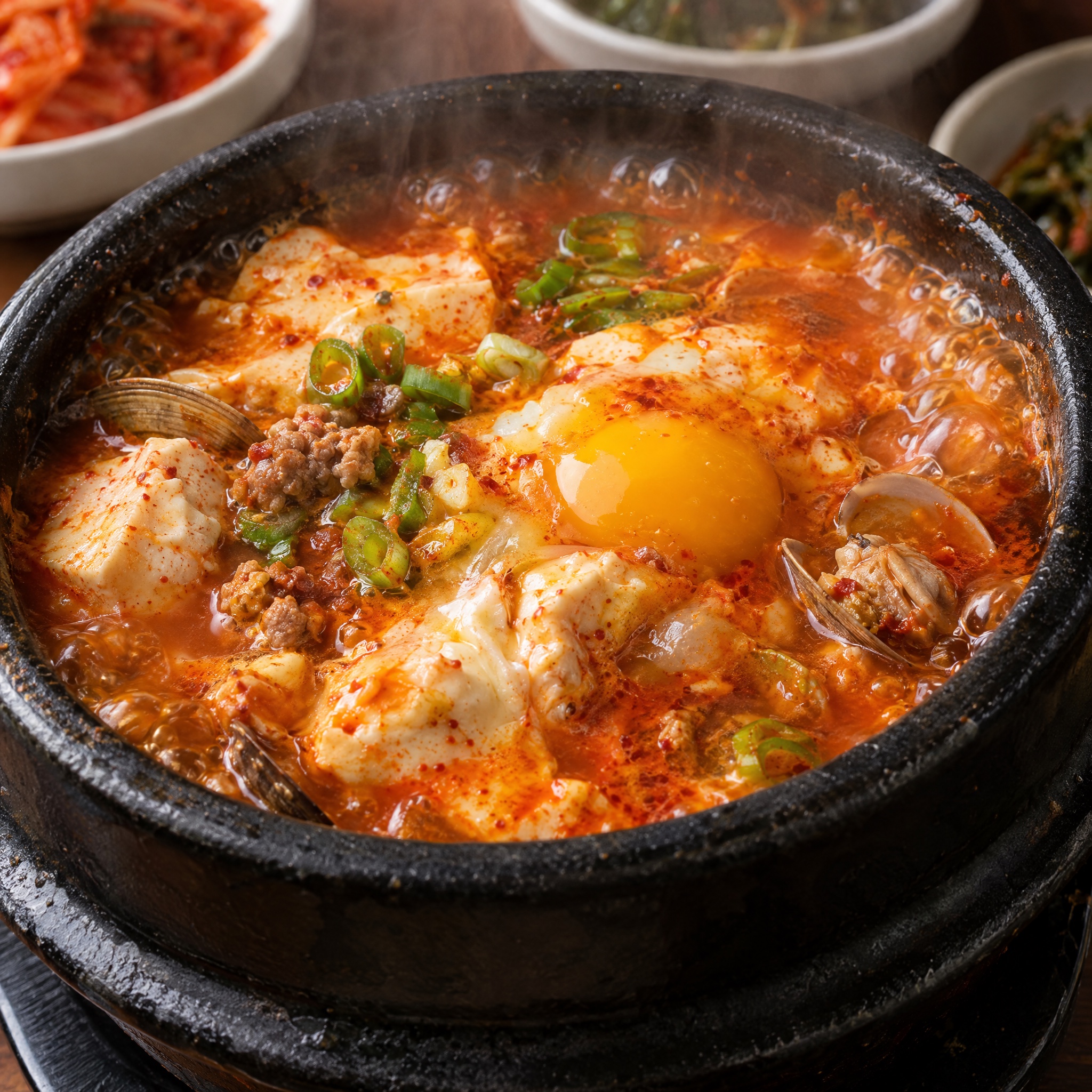
A raging bowl of soft tofu, chilli broth and a cracked egg — the stew you eat before the spoon melts.
Recipe by I Want Some Food · Reviewed by the editorial kitchen. Native name preserved: 순두부찌개.
0 people cooked this in the public kitchen yet. Kitchen-tested by I Want Some Food. Not a purchased rating.
- Prep
- 15 min
- Cook
- 20 min
- Rest
- None
- Total
- 35 min
- Difficulty
- Easy
- Spice
- Hot
- Cost
- Weeknight budget$8–16 USD · indicative, not a store price
About
Sundubu is extra-soft tofu that barely holds a cube. The broth is gochugaru and stock, sometimes clams or pork, always served boiling. You break an egg into it at the table. If your tofu is firm, you have made a different jjigae — still good, not this. Buy extra-soft silken tofu sold for stew; firm cubes are a different jjigae. Bloom gochugaru in oil, add anchovy or dashima stock, then slide the tofu in and do not stir it to pieces. Serve at a rolling boil. The egg should silk in the broth at the table, not scramble in the pot; done is wobbling tofu, a red slick on top, and broth that tastes of chilli and sea or pork, not just salt.
Ingredients
Scaling multiplies the written quantities. Baking still prefers a scale.
Steps
Step 1
Bloom gochugaru and garlic in sesame oil over medium heat 30 seconds. Add pork if using and stir until it loses raw colour.
4 minStep 2
Add stock, soy, gochujang, onion and zucchini. Boil 5 minutes.
5 minStep 3
Slide in the soft tofu in large spoonfuls. Add prawns. Return to a hard boil 3–4 minutes. Do not stir into mush.
4 minStep 4
Crack eggs on top, scatter spring onion, and take the pot to the table still bubbling.
Adapt this recipe
The canonical recipe stays intact. Personal versions are labelled. Serving changes are maths, not AI.
Adaptations · 0 / 15 used. Resets 10 October.
Substitutions
Seafood → Mushrooms only
Check your stock. Use dashima water, skip anchovy.
Tips
- Clams instead of prawns is the other classic.
- If you only have firm tofu, cube it — call it dubu-jjigae and do not apologise.
History & culture
Late-night restaurants specialise in this pot. At home a small earthen ttukbaegi is traditional; a saucepan works. Rice on the side is not negotiable. Late-night sundubu rooms still put a bubbling ttukbaegi in front of each person. Busan-leaning pots run to clams and prawns; Seoul home versions often take pork. Korean-American chains made the seafood-red bowl a lunch standard abroad. Rice on the side is assumed; haejang after drinking is a common reason to order it, not the only one.
Soft-tofu stews are home and restaurant food across the south. The bright-red seafood version is the one that travelled. Factory-made extra-soft tofu in the twentieth century is what made this stew ordinary. The loud seafood restaurant pot is the bowl that crossed oceans, including through Korean-American shops in the 1990s. It is home and stewhouse food, not an ancient named classic we can pin to a court. Date the familiar red bubble as modern.
Traditional
Provenance: Editorial adaptation.
Questions about this recipe
Answers taken from this dish's times, amounts, swaps and tips — not a chatbot.
How long does Sundubu jjigae take?
35 min all in — 15 min prep, 20 min cook. Cook and rest follow the method. Leftover storage and optional extra waits are not included.
How many does it serve?
The recipe is written for 2 pots. Scale the ingredient list on the page if you are cooking for a different number.
How hard is it?
Easy.
How spicy is it?
Hot.
What allergens should I watch?
This recipe is labelled for Soy, Eggs, Fish, Shellfish. Labels are informational — check the packets in your kitchen. This is not medical advice.
Does it fit a diet?
The published recipe is labelled Gluten-free, Dairy-free, Nut-free.
What does it cost to cook?
Weeknight budget — about $8–16 USD, as a grocery budget for this recipe, not a restaurant price.
What equipment do I need?
Saucepan.
How much salt do I put in?
This recipe does not list salt as its own ingredient. Saltiness comes from Gochujang — 1 tsp (optional); Soy sauce — 1 tbsp. Taste at the end rather than adding a number we did not write.
How much gochugaru?
2 tbsp of Gochugaru.
How much gochujang?
1 tsp (optional) of Gochujang.
How much soy sauce?
1 tbsp of Soy sauce.
How much toasted sesame oil?
1 tbsp of Toasted sesame oil.
What can I use instead?
Seafood → Mushrooms only. Check your stock. Use dashima water, skip anchovy.
Any tips from this recipe?
Clams instead of prawns is the other classic. If you only have firm tofu, cube it — call it dubu-jjigae and do not apologise.
Can I use an air fryer?
This method is not written for an air fryer. The core technique on the page still applies.
Similar dishes
Checking your allergy settings…