


Budae jjigae
부대찌개
Army-base stew: kimchi, spam, sausages and ramyeon in a gochujang broth that refuses to be precious.
Recipe by I Want Some Food · Reviewed by the editorial kitchen. Native name preserved: 부대찌개.
0 people cooked this in the public kitchen yet. Kitchen-tested by I Want Some Food. Not a purchased rating.
- Prep
- 15 min
- Cook
- 25 min
- Rest
- None
- Total
- 40 min
- Difficulty
- Easy
- Spice
- Hot
- Cost
- Weeknight budget$8–16 USD · indicative, not a store price
About
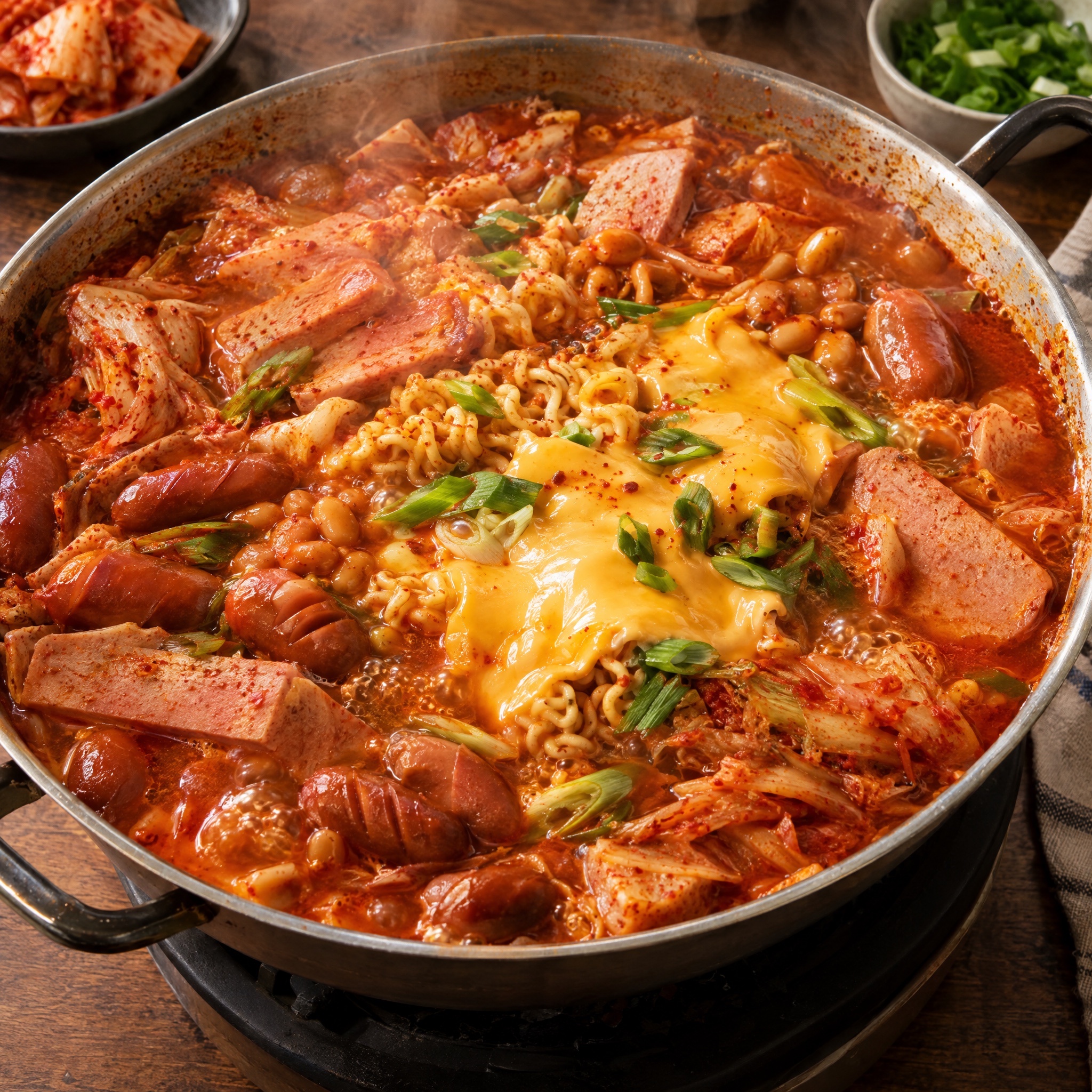
Budae jjigae is a pot born of surplus and invention. Kimchi broth, sliced spam, hot dogs, baked beans if you are old-school, tofu, and a brick of ramyeon at the end. It is loud, salty and meant to be shared from one pan. This is not fusion as a restaurant idea. It is history you can still taste. Fry the kimchi in a little oil before the stock so the pot is sour-deep, not just salty-pink. Slice the spam and sausages thin so they season the broth instead of sitting as cold bricks. Add the ramyeon brick and its powder in the last two minutes. Done is a shared boil, noodles still springy, broth loud with chilli and cured-meat salt; baked beans are optional nostalgia — they sweeten the pot whether you like that or not.
Ingredients
- Kimchi, chopped, plus juice250 g
- Spam, sliced200 g
- Pork, sausages or hot dogs, sliced150 g
- Tofu, sliced200 g
- Gochujang15 ml
- Gochugaru15 ml
- Soy sauce15 ml
- Garlic3 clove
- Wheat noodles, instant ramyeon noodles, seasoning packet optional1 block
- Garaetteok (optional)100 g
- Melting cheese (optional)40 g
- Water700 ml
- Rice, uncooked, to serve300 g
Scaling multiplies the written quantities. Baking still prefers a scale.
Steps
Step 1
Brown spam and sausage slices in a wide pot. Push aside. Add kimchi, garlic and onion and fry 3 minutes.
6 minStep 2
Stir in gochujang, gochugaru, soy and water. Arrange tofu and tteok on top. Simmer 10 minutes.
10 minStep 3
Add ramyeon noodles for the last 3 minutes. Cheese and spring onion. Eat from the pot with rice on the side.
Adapt this recipe
The canonical recipe stays intact. Personal versions are labelled. Serving changes are maths, not AI.
Adaptations · 0 / 15 used. Resets 10 October.
Substitutions
Spam → Ham or leftover roast pork
You lose the specific canned flavour. Still a pot.
Tips
- Baked beans are traditional in some Uijeongbu pots. A spoon is enough.
- Do not dump the whole ramyeon seasoning packet unless you like salt as a sport.
History & culture
Uijeongbu is the pilgrimage. Students and groups still cook it at the table. Call it what it is: a postwar stew that became comfort food. Uijeongbu and other camp-town streets still sell it as a destination pot. Campus cooking and table-top restaurants treat it as group food with soju. Younger cooks skip the beans; older ones sometimes insist. It is comfort now, ordered without a history lecture, which is how leftover dishes graduate.
US army-base surplus meats met Korean kimchi pots after the Korean War. We do not romanticise the hunger. We do record the dish that came out of it. American base-town tins and sausages met leftover kimchi broth in the 1950s and 1960s. That is camp-town cooking, not 'fusion' as a chef's idea. Nostalgia restaurants from the 1990s plated it for people who no longer needed the calories. We do not romanticise the shortage, but we do date the stew as postwar food you can still taste.
Modern adaptation — Spam and sausages are the point. Skip them and you have kimchi jjigae.
Provenance: Editorial adaptation.
Questions about this recipe
Answers taken from this dish's times, amounts, swaps and tips — not a chatbot.
How long does Budae jjigae take?
40 min all in — 15 min prep, 25 min cook. Cook and rest follow the method. Leftover storage and optional extra waits are not included.
How many does it serve?
The recipe is written for 4 pots. Scale the ingredient list on the page if you are cooking for a different number.
How hard is it?
Easy.
How spicy is it?
Hot.
What allergens should I watch?
This recipe is labelled for Soy, Wheat, Fish. Labels are informational — check the packets in your kitchen. This is not medical advice.
Does it fit a diet?
The published recipe is labelled Dairy-free, Nut-free.
What does it cost to cook?
Weeknight budget — about $8–16 USD, as a grocery budget for this recipe, not a restaurant price.
What equipment do I need?
Dutch oven, Saucepan.
How much salt do I put in?
This recipe does not list salt as its own ingredient. Saltiness comes from Kimchi — 250 g (chopped, plus juice); Gochujang — 1 tbsp; Soy sauce — 1 tbsp. Taste at the end rather than adding a number we did not write.
How much kimchi?
250 g (chopped, plus juice) of Kimchi.
How much gochujang?
1 tbsp of Gochujang.
How much gochugaru?
1 tbsp of Gochugaru.
How much soy sauce?
1 tbsp of Soy sauce.
What can I use instead?
Spam → Ham or leftover roast pork. You lose the specific canned flavour. Still a pot.
Any tips from this recipe?
Baked beans are traditional in some Uijeongbu pots. A spoon is enough. Do not dump the whole ramyeon seasoning packet unless you like salt as a sport.
Can I use an air fryer?
This method is not written for an air fryer. The core technique on the page still applies.
Similar dishes
Checking your allergy settings…