


Tom yum goong
ต้มยำกุ้ง
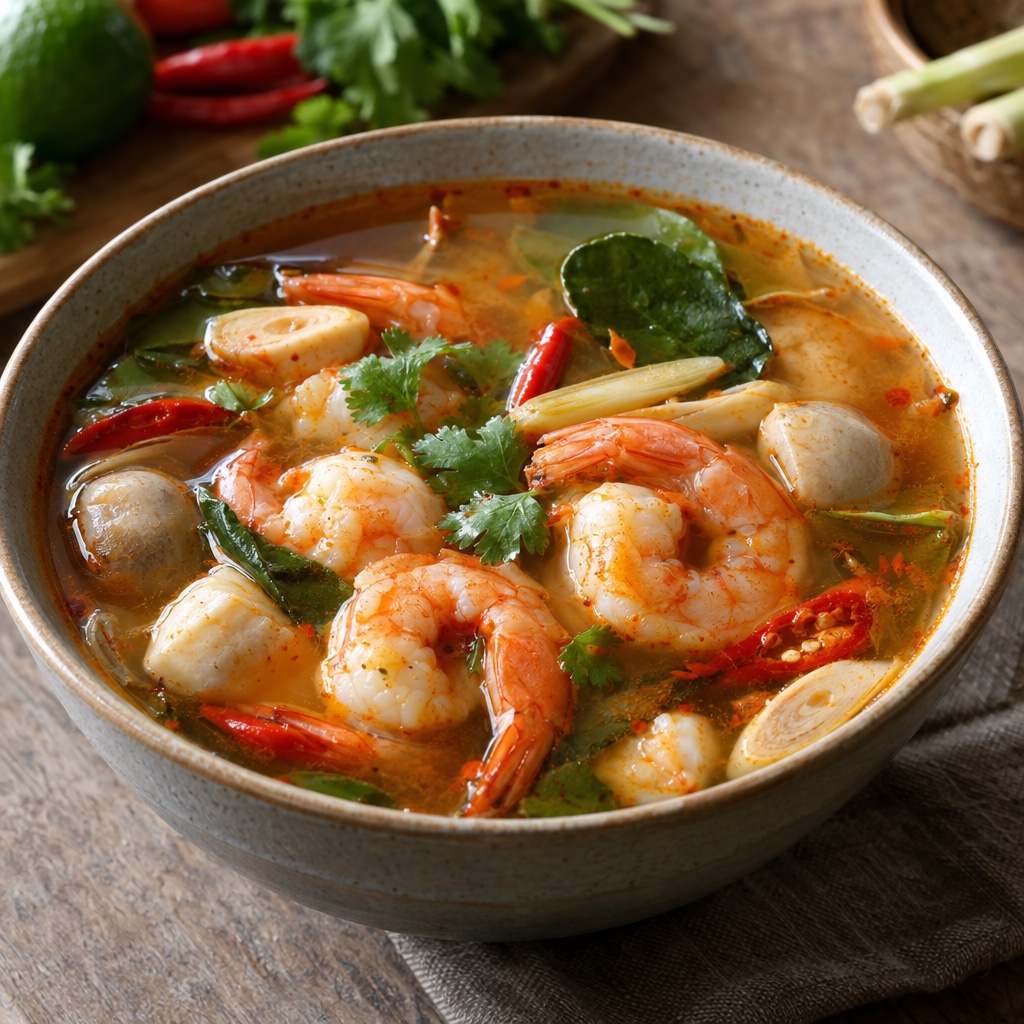
Hot-and-sour Thai prawn soup — lemongrass, lime leaf, chilli and a broth that should make you blink.
Recipe by I Want Some Food · Reviewed by the editorial kitchen. Native name preserved: ต้มยำกุ้ง.
0 people cooked this in the public kitchen yet. Kitchen-tested by I Want Some Food. Not a purchased rating.
- Prep
- 15 min
- Cook
- 20 min
- Rest
- None
- Total
- 35 min
- Difficulty
- Easy
- Spice
- Hot
- Cost
- Weeknight budget$8–16 USD · indicative, not a store price
About
Tom yum is a clear-ish sour soup, not a coconut curry (that is tom kha). You bruise lemongrass, galangal and lime leaves in stock, add prawns at the end, and finish with fish sauce, lime and roasted chilli paste if you have it. The bowl should smell like a garden argument: citrus, chilli, prawn. Bruise the aromatics; pretty floating sticks that were never cracked taste of nothing. Galangal is not ginger — if you substitute, say so and use less, because the flavour is wrong rather than 'close enough'. Prawns overcook in a minute; the broth should already be sour-salty-hot before they go in. Nam prik pao (roasted chilli paste) adds smoke and colour; without it the soup can taste thin even when the lime is right. Mushrooms are optional furniture. If it is cloudy from boiling prawn heads too hard, strain. Balance at the end with lime, not with a sugar dump unless it is harshly sour.
Ingredients
- Prawn, shell-on if you can, peeled to serve250 g
- Lemongrass, bashed and cut into lengths2 stalk
- Lime, juiced, plus extra wedges2
- Fish sauce30 ml
- Fresh chilli, bruised, to taste4 small
- Mushrooms, straw or oyster, halved100 g
- Shallot, bruised2
- Garlic2 clove
- Coriander1 handful
- Palm sugar (optional)4.9 ml
- Water, or light stock; add prawn heads if you have them700 ml
Scaling multiplies the written quantities. Baking still prefers a scale.
Steps
Step 1
Simmer water with lemongrass, shallot, garlic and chilli 8 minutes until the pot smells loud.
8 minStep 2
Add mushrooms 2 minutes. Add prawns and cook just until they curl and turn opaque, 2–3 minutes.
5 minWatch: Overcooked prawns are expensive rubber.
Step 3
Take off the heat. Season with fish sauce, lime juice and a pinch of palm sugar only if it tastes hollow.
2 minStep 4
Taste: sour, salty, hot, a little sweet. Add coriander. Serve immediately.
Adapt this recipe
The canonical recipe stays intact. Personal versions are labelled. Serving changes are maths, not AI.
Adaptations · 0 / 15 used. Resets 10 October.
Substitutions
Prawns → Firm white fish or just mushrooms
Tom yum het is a real bowl. Check fish sauce if you need it vegetarian.
Tips
- Makrut lime leaves and galangal are the missing perfume if your Asian grocer has them — bruise and add with the lemongrass.
- Cloudy tom yum with nam prik pao is a restaurant style, not a mistake.
History & culture
Central Thai restaurant soup that became a national export. Street pots and hotel buffets both claim it. Heat is personal; sour should not be. A central Thai restaurant still uses this soup as a hello: loud, fragrant, shared. Heat is personal and sour is the structure. Hotel buffets taught the world a version with too many straw mushrooms and not enough lime. Homes keep kaffir lime leaves in the freezer because the bowl is otherwise impossible. Fish sauce in the kitchen is assumed. A coconut version is a different soup with a different job. Keep this one sharp.
Aromatic sour soups are older than the tourist menu. The prawn version (goong) is the one most kitchens outside Thailand mean. Clear sour broths scented with herbs were already household cooking long before a prawn in a red bowl became a postcard. Goong as the export standard followed refrigeration and restaurant menus that wanted a luxury protein. The stalk, the rhizome, and the kaffir leaf are the botanical history. Chilli is later in Thai cooking than people think, and still essential now. Tinned paste and frozen prawns are how a London weeknight joins that history. Join it, then taste for lime.
Regional variation — No coconut milk. Nam prik pao (roasted chilli jam) is traditional in many restaurant bowls and optional here.
Provenance: Editorial adaptation.
Questions about this recipe
Answers taken from this dish's times, amounts, swaps and tips — not a chatbot.
How long does Tom yum goong take?
35 min all in — 15 min prep, 20 min cook. Cook and rest follow the method. Leftover storage and optional extra waits are not included.
How many does it serve?
The recipe is written for 2 bowls. Scale the ingredient list on the page if you are cooking for a different number.
How hard is it?
Easy.
How spicy is it?
Hot.
What allergens should I watch?
This recipe is labelled for Shellfish, Fish. Labels are informational — check the packets in your kitchen. This is not medical advice.
Does it fit a diet?
The published recipe is labelled Pescatarian, Dairy-free, Gluten-free.
What does it cost to cook?
Weeknight budget — about $8–16 USD, as a grocery budget for this recipe, not a restaurant price.
What equipment do I need?
Saucepan, Chef's knife.
How much salt do I put in?
This recipe does not list salt as its own ingredient. Saltiness comes from Fish sauce — 2 tbsp. Taste at the end rather than adding a number we did not write.
How much fish sauce?
2 tbsp of Fish sauce.
What can I use instead?
Prawns → Firm white fish or just mushrooms. Tom yum het is a real bowl. Check fish sauce if you need it vegetarian.
What should I watch for?
Overcooked prawns are expensive rubber.
Any tips from this recipe?
Makrut lime leaves and galangal are the missing perfume if your Asian grocer has them — bruise and add with the lemongrass. Cloudy tom yum with nam prik pao is a restaurant style, not a mistake.
Can I use an air fryer?
This method is not written for an air fryer. The core technique on the page still applies.
Similar dishes
Checking your allergy settings…