


Pad thai
ผัดไทย
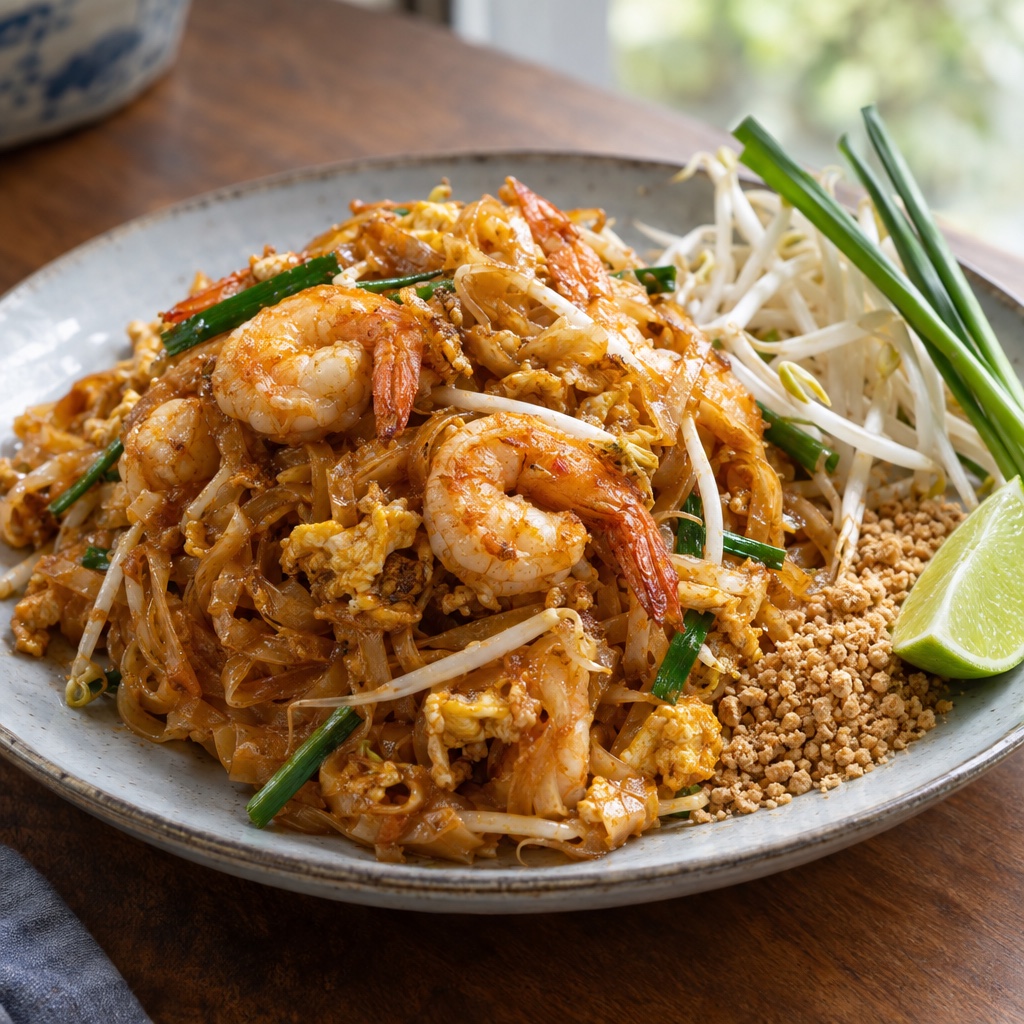
Stir-fried rice noodles with tamarind, fish sauce, palm sugar, egg and peanuts — a national dish with a 20th-century origin story.
Recipe by I Want Some Food · Reviewed by the editorial kitchen. Native name preserved: ผัดไทย.
0 people cooked this in the public kitchen yet. Kitchen-tested by I Want Some Food. Not a purchased rating.
- Prep
- 25 min
- Cook
- 15 min
- Rest
- None
- Total
- 40 min
- Difficulty
- Medium
- Spice
- Mild
- Cost
- Weeknight budget$8–16 USD · indicative, not a store price
About
Pad thai is wok cooking plus a sour-sweet-salty sauce. The noodles should be chewy, not sodden; the sauce should cling; the peanuts should be last. This is a home-wok version. A Thai steel wok over a roaring burner will always beat a suburban hob. We compensate with a hot pan, small batches, and noodles that were soaked, not boiled to death. Soak medium rice sticks until they bend but still have a chalky core; boiling them first is how you get mash. Tamarind pulp beats ketchup, though a little of the latter is how some stalls stretch the sour. Cook in batches in a ripping pan so the sauce caramelises instead of steaming. Done is chewy noodles, sauce clinging, prawns just opaque; if the pan looks wet, you overcrowded it.
Ingredients
- Rice noodles, dried sen lek, soaked180 g
- Prawn, peeled (optional)150 g
- Tofu, firm, cubed (optional)100 g
- Egg2 large
- Shallot, sliced2
- Garlic, minced2 clove
- Tamarind, paste or thick tamarind water30 ml
- Fish sauce22 ml
- Palm sugar22 ml
- Fresh chilli, sliced, to taste (optional)1 small
- Bean sprouts80 g
- Peanuts, roasted, crushed30 g
- Lime, wedges1
- Spring onion, cut into lengths2
Scaling multiplies the written quantities. Baking still prefers a scale.
Steps
Step 1
Soak noodles in warm water until bendy but still firm, 20–40 minutes depending on brand. Drain. Mix tamarind, fish sauce and palm sugar into a sauce. Taste: sour, salty, sweet, in that conversation.
25 minStep 2
Heat the wok until very hot. Oil, then prawns or tofu until just coloured. Remove.
3 minStep 3
Add a little more oil, shallot and garlic, 20 seconds. Push aside, scramble the eggs, then toss together.
2 minStep 4
Add noodles and sauce. Toss hard, scraping the pan, until the noodles absorb the sauce and look stained, 2–3 minutes. If they stick, a splash of water — not a flood.
3 minWatch: Overcrowding makes steam, not wok flavour. Cook two portions max.
Step 5
Return prawns or tofu. Add most of the bean sprouts and spring onion. Toss 30 seconds. Serve with peanuts, remaining sprouts, chilli and lime.
2 min
Adapt this recipe
The canonical recipe stays intact. Personal versions are labelled. Serving changes are maths, not AI.
Adaptations · 0 / 15 used. Resets 10 October.
Substitutions
Palm sugar → Light brown sugar
A little less complex. Fine.
Prawns → Pressed tofu only
A common stall option. Check fish sauce if you need it vegetarian — there is no true substitute, only omission.
Tips
- The sauce should be mixed before the wok is hot. Pad thai is not the moment to hunt for palm sugar.
- If it tastes flat, it needs tamarind or lime, not more ketchup. Ketchup pad thai is a different, sweeter diaspora style — name it if you cook it.
History & culture
You will meet pad thai as street food, hotel buffet, and diaspora takeaway. The best versions are still cooked to order in a hot wok. Prawns are common; pressed tofu and dried shrimp appear in many stalls. Garnish with lime and let people adjust. In Thailand it is one street order among many, not the national dinner every night. Chinese-Thai shophouses still cook it to order; hotel buffets are where it goes soft. Diaspora takeaways sweeten it for local palates — pull the sugar back if you want the sour-salty version. Lime and chilli flakes stay on the side so each person can finish their own plate.
Pad thai was popularised in the 20th century as a national noodle dish with Chinese stir-fry technique and Thai seasoning. It is Thai. It is also modern. Both things are true. The dish was pushed as a national noodle in the twentieth century, often tied to state campaigns rather than an old court kitchen. The wok method is Chinese-Thai; the tamarind-fish-sauce-palm-sugar balance is the local part. Export restaurants from the 1970s onwards froze a sweet-orange image that home woks do not have to copy. It is Thai, and it is modern shop food.
Modern adaptation — Dried shrimp and preserved radish are traditional in many stall versions and omitted here for a smaller pantry. Add them if you have them.
Provenance: Editorial adaptation. Original editorial adaptation for I Want Some Food. Photograph: I Want Some Food generated editorial photography (Editorial supply).
Questions about this recipe
Answers taken from this dish's times, amounts, swaps and tips — not a chatbot.
How long does Pad thai take?
40 min all in — 25 min prep, 15 min cook. Cook and rest follow the method. Leftover storage and optional extra waits are not included.
How many does it serve?
The recipe is written for 2 plates. Scale the ingredient list on the page if you are cooking for a different number.
How hard is it?
Medium.
How spicy is it?
Mild.
What allergens should I watch?
This recipe is labelled for Fish, Eggs, Peanuts, Shellfish, Soy. Labels are informational — check the packets in your kitchen. This is not medical advice.
Does it fit a diet?
The published recipe is labelled Pescatarian, Gluten-free, Dairy-free.
What does it cost to cook?
Weeknight budget — about $8–16 USD, as a grocery budget for this recipe, not a restaurant price.
What equipment do I need?
Wok, Mixing bowl.
How much salt do I put in?
This recipe does not list salt as its own ingredient. Saltiness comes from Fish sauce — 1½ tbsp. Taste at the end rather than adding a number we did not write.
How much fish sauce?
1½ tbsp of Fish sauce.
What can I use instead?
Palm sugar → Light brown sugar. A little less complex. Fine. Prawns → Pressed tofu only. A common stall option. Check fish sauce if you need it vegetarian — there is no true substitute, only omission.
What should I watch for?
Overcrowding makes steam, not wok flavour. Cook two portions max.
Any tips from this recipe?
The sauce should be mixed before the wok is hot. Pad thai is not the moment to hunt for palm sugar. If it tastes flat, it needs tamarind or lime, not more ketchup. Ketchup pad thai is a different, sweeter diaspora style — name it if you cook it.
Can I use an air fryer?
This method is not written for an air fryer. The core technique on the page still applies.
Similar dishes
Checking your allergy settings…