


Seolleongtang
설렁탕
A milky ox-bone broth you season at the table — salt, spring onion, and patience in a bowl.
Recipe by I Want Some Food · Reviewed by the editorial kitchen. Native name preserved: 설렁탕.
0 people cooked this in the public kitchen yet. Kitchen-tested by I Want Some Food. Not a purchased rating.
- Prep
- 30 min
- Cook
- 6 hr
- Rest
- None
- Total
- 6 hr 30 min
- Difficulty
- A bit of work
- Spice
- No chilli
- Cost
- A bit special$16–28 USD · indicative, not a store price
About
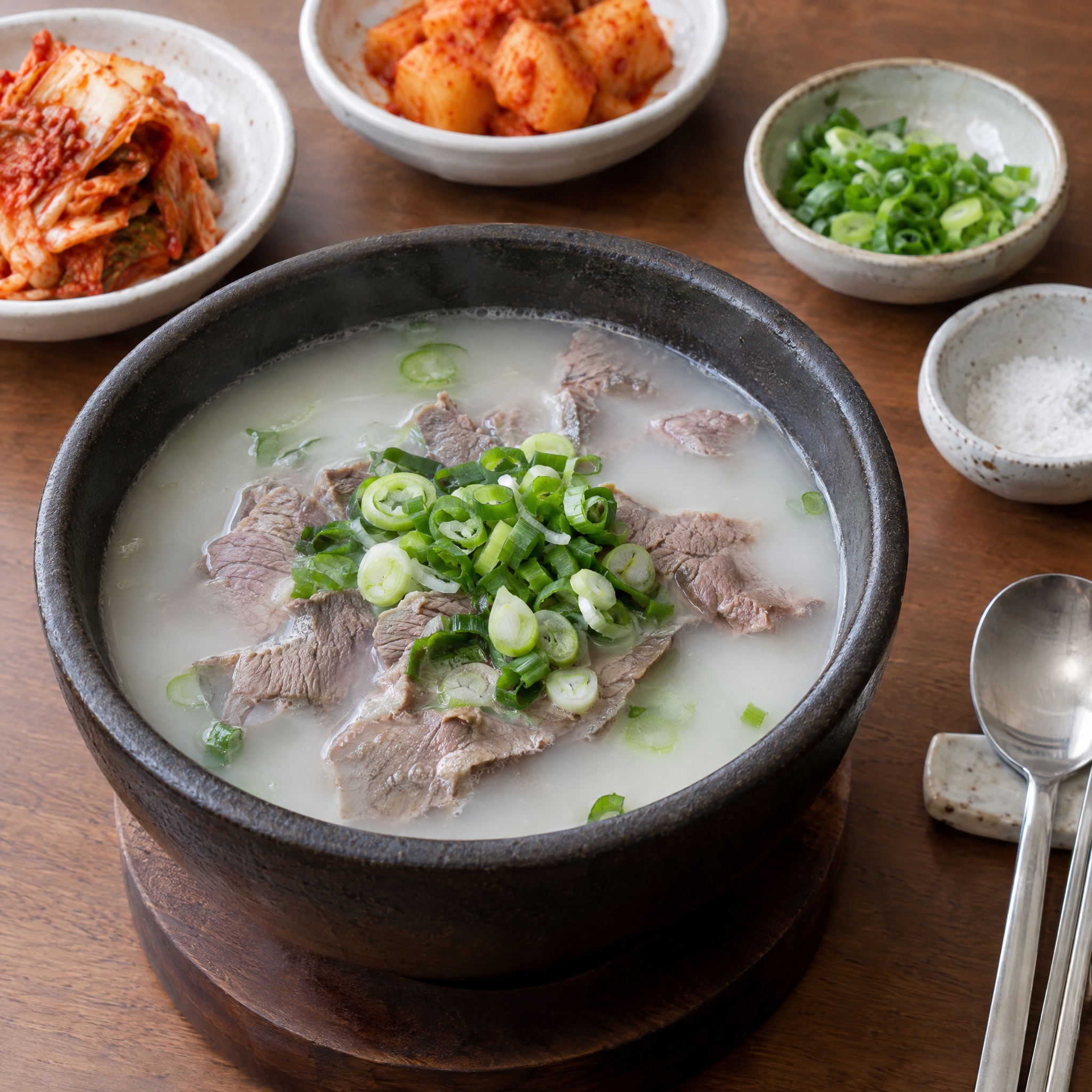
Seolleongtang looks bland until you salt it. The work is a long simmer of beef bones until the broth turns opaque and pale. You shred the meat, add noodles or rice, and let each person finish the bowl. If you only have two hours, make something else. This pot needs the night. Roast or blanch the bones, then give them most of a day until the liquid turns cloudy-white. Do not salt the cauldron hard — each bowl is finished at the table. Shred the meat when it gives. Done is a milky pot with dots of fat, meat that pulls, and a quiet beef taste waiting for salt and spring onion; two hours will not get you there, and a brown thin stock means you never extracted the collagen.
Ingredients
- Beef, leg bones plus 500g brisket or similar simmering cut2 kg
- Water4 l
- Spring onion, whites for the pot, greens to serve6
- Garlic8 clove
- Salt, plus more at the table4.9 ml
- Black pepper4.9 ml
- Wheat noodles, or just rice (optional)400 g
- Rice, uncooked, to serve400 g
- Kimchi, to serve200 g
Scaling multiplies the written quantities. Baking still prefers a scale.
Steps
Step 1
Cover bones and meat with cold water, boil 10 minutes, drain and rinse. This first boil is not the soup — it is the clean-up.
15 minStep 2
Return bones and meat to a clean pot with 4 litres water, onion, garlic and spring-onion whites. Simmer uncovered 6–8 hours, topping up so the bones stay under. The broth should go milky.
360 minTip: A pressure cooker cuts this to about 2 hours. The flavour is still honest.
Step 3
Lift the meat, shred it. Strain the broth. Chill if you can and lift the hard fat, or skim.
20 minStep 4
Reheat, salt lightly. Serve with shredded beef, noodles or rice, spring-onion greens, pepper and kimchi. The diner finishes the salt.
Adapt this recipe
The canonical recipe stays intact. Personal versions are labelled. Serving changes are maths, not AI.
Adaptations · 0 / 15 used. Resets 10 October.
Substitutions
Leg bones → A smaller mix of marrow bones from the butcher
Ask for soup bones. Stewing steak alone will not go milky.
Tips
- Kkakdugi (radish kimchi) is the classic side, not only baechu.
- The pot is better on day two.
History & culture
Seoul breakfast and hangover food. Shops keep a cauldron going. At home it is a weekend project that becomes weekday lunches. Old Seoul shops still sell it as breakfast and as hangover food, cauldron on since dawn. Kkakdugi on the side is part of the bowl, not a pickle afterthought. Office workers duck in before the day starts. Weekend home pots become weekday reheats, which is the only sane way to cook it in a flat.
Often linked to royal and commoner ox-bone soups in Seoul. The modern shop bowl — milky, lightly seasoned, kimchi on the side — is what travelled. Ox-bone soups have royal and commoner stories in Seoul; the evidence for a single court origin is thinner than the shop myth. The modern milky, lightly seasoned bowl with kimchi on the side is specialised twentieth-century restaurant food. Colonial-period and postwar soup houses fixed the style people now mean. We are writing that shop bowl, not a reconstructed palace service.
Traditional
Provenance: Editorial adaptation.
Questions about this recipe
Answers taken from this dish's times, amounts, swaps and tips — not a chatbot.
How long does Seolleongtang take?
6 hr 30 min all in — 30 min prep, 6 hr cook. Cook and rest follow the method. Leftover storage and optional extra waits are not included.
How many does it serve?
The recipe is written for 6 bowls. Scale the ingredient list on the page if you are cooking for a different number.
How hard is it?
A bit of work.
How spicy is it?
No chilli.
What allergens should I watch?
This recipe is labelled for Wheat, Fish, Shellfish. Labels are informational — check the packets in your kitchen. This is not medical advice.
Does it fit a diet?
The published recipe is labelled Dairy-free, Nut-free.
What does it cost to cook?
A bit special — about $16–28 USD, as a grocery budget for this recipe, not a restaurant price.
What equipment do I need?
Stockpot.
How much salt do I put in?
The recipe lists Salt at 1 tsp (plus more at the table).
How much kimchi?
200 g (to serve) of Kimchi.
What can I use instead?
Leg bones → A smaller mix of marrow bones from the butcher. Ask for soup bones. Stewing steak alone will not go milky.
Any tips from this recipe?
Kkakdugi (radish kimchi) is the classic side, not only baechu. The pot is better on day two.
Can I prepare this ahead?
Reheat, salt lightly. Serve with shredded beef, noodles or rice, spring-onion greens, pepper and kimchi. The diner finishes the salt.
Can I use an air fryer?
This method is not written for an air fryer. The core technique on the page still applies.
Similar dishes
Checking your allergy settings…