


Dakgalbi
닭갈비
Spicy stir-fried chicken with rice cakes, cabbage and sweet potato — Chuncheon's table-grill export.
Recipe by I Want Some Food · Reviewed by the editorial kitchen. Native name preserved: 닭갈비.
0 people cooked this in the public kitchen yet. Kitchen-tested by I Want Some Food. Not a purchased rating.
- Prep
- 25 min
- Cook
- 25 min
- Rest
- None
- Total
- 50 min
- Difficulty
- Medium
- Spice
- Hot
- Cost
- A bit special$16–28 USD · indicative, not a store price
About
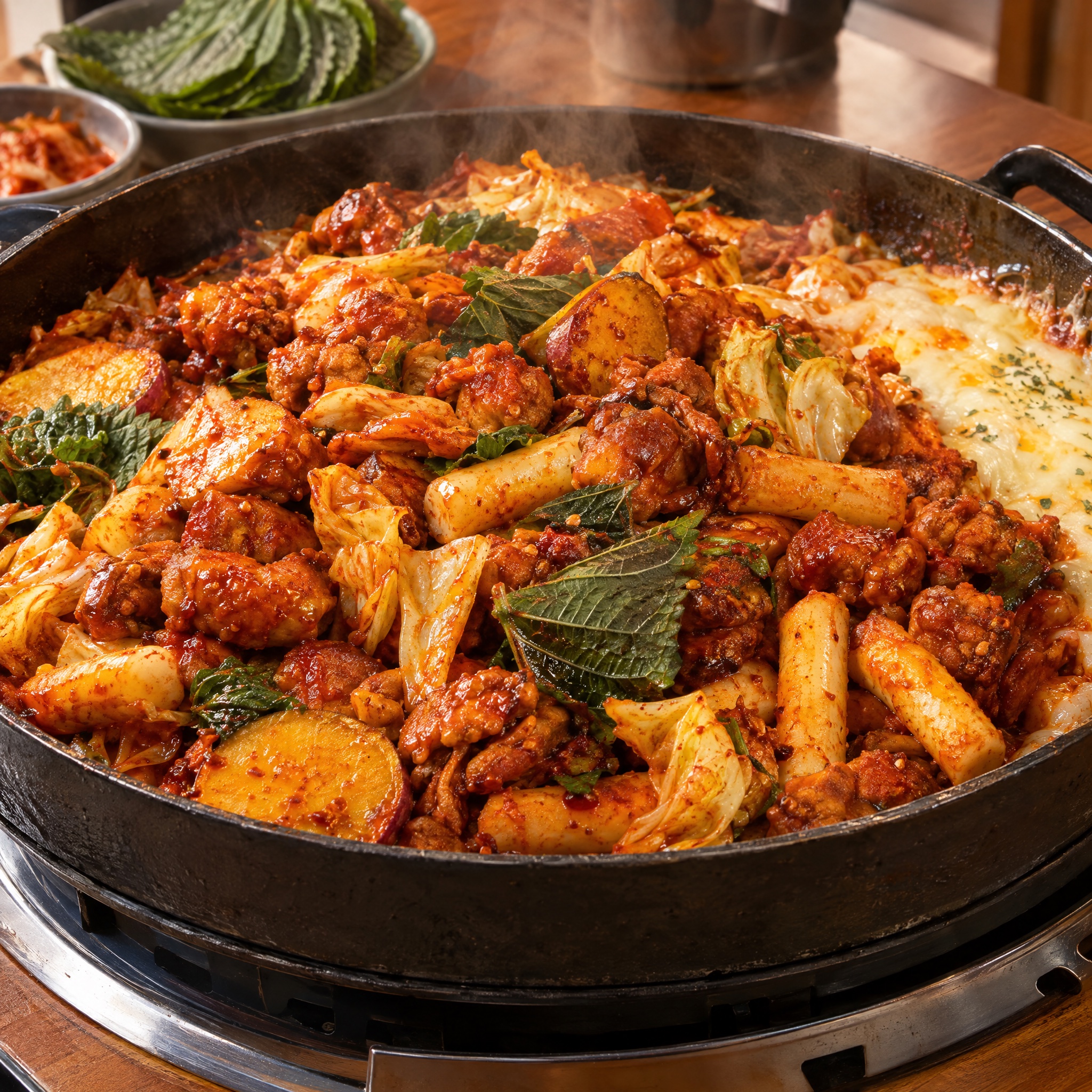
Dakgalbi is a wide pan of chicken, cabbage, tteok and a gochujang sauce cooked until everything is stained red. In Chuncheon it is a table-top spectacle. At home it is one skillet and a lid. Add cheese at the end if you want the 2010s version. Either way, finish by frying leftover rice in the pan scrapings. Use boneless thigh, a lot of cabbage, and rice cakes that have had a soak so they do not stay hard in the middle of the pan. Cook covered until the chicken is through, then uncover to thicken. Done is stained cabbage that still has a little structure, chewy tteok, and a sauce that clings rather than floods. Cheese, if you want it, goes on at the end off a hard boil; the leftover-rice fry in the scrapings is a second recipe you should budget time for.
Ingredients
- Chicken, boneless thigh, bite-size700 g
- Gochujang44 ml
- Gochugaru15 ml
- Soy sauce15 ml
- Sugar15 ml
- Korean rice wine15 ml
- Garlic5 clove
- Toasted sesame oil15 ml
- Napa cabbage, chunked300 g
- Sweet potato, half-moons1 small
- Garaetteok, soaked (optional)200 g
- Onion, sliced1
- Melting cheese (optional)80 g
- Rice, cooked, for the leftover-pan fry200 g
Scaling multiplies the written quantities. Baking still prefers a scale.
Steps
Step 1
Mix gochujang, gochugaru, soy, sugar, rice wine, garlic and sesame oil with the chicken. Marinate 15 minutes.
15 minStep 2
In a wide pan, cook chicken and onion 5 minutes. Add cabbage, sweet potato and tteok. Cover and cook, stirring, until the potato is tender and the sauce clings, 12–15 minutes.
15 minStep 3
Add spring onion. Melt cheese on top if using. Push everything aside, add leftover rice to the red oil, and fry it as a second course.
6 minTip: The fried rice is why people fight over the pan.
Adapt this recipe
The canonical recipe stays intact. Personal versions are labelled. Serving changes are maths, not AI.
Adaptations · 0 / 15 used. Resets 10 October.
Substitutions
Sweet potato → Ordinary potato
Less sweet, still correct enough.
Tips
- Perilla leaves under the cheese are a Chuncheon flourish if you can find them.
- If the pan dries, a splash of water — not more paste.
History & culture
Chuncheon is the pilgrimage city. Students and groups share one pan. The fried-rice encore is not optional if you did it right. Chuncheon is still the pilgrimage — students and hiking groups share one pan. University MT trips treat it as date and group food. Chain shops elsewhere copy the spectacle with a table burner. Locals will tell you the fried-rice encore is the point of going.
Mid-century chicken grill food that became a regional brand, then a national delivery category. Cheese is a later layer. Chuncheon restaurants turned a mid-century chicken stir-fry into a regional brand from the 1960s and 1970s, then a national delivery category. It is not palace food. Cheese is a 2000s–2010s layer. We date the spectacle to those shops, not to an older countryside stew that merely used similar chilli.
Regional variation — Chuncheon-style is the reference. Cheese is optional and popular.
Provenance: Editorial adaptation.
Questions about this recipe
Answers taken from this dish's times, amounts, swaps and tips — not a chatbot.
How long does Dakgalbi take?
50 min all in — 25 min prep, 25 min cook. Cook and rest follow the method. Leftover storage and optional extra waits are not included.
How many does it serve?
The recipe is written for 4 pans. Scale the ingredient list on the page if you are cooking for a different number.
How hard is it?
Medium.
How spicy is it?
Hot.
What allergens should I watch?
This recipe is labelled for Soy, Wheat, Sesame. Labels are informational — check the packets in your kitchen. This is not medical advice.
Does it fit a diet?
The published recipe is labelled Dairy-free, Nut-free.
What does it cost to cook?
A bit special — about $16–28 USD, as a grocery budget for this recipe, not a restaurant price.
What equipment do I need?
Frying pan, Dutch oven.
How much salt do I put in?
This recipe does not list salt as its own ingredient. Saltiness comes from Gochujang — 3 tbsp; Soy sauce — 1 tbsp. Taste at the end rather than adding a number we did not write.
How much gochujang?
3 tbsp of Gochujang.
How much gochugaru?
1 tbsp of Gochugaru.
How much soy sauce?
1 tbsp of Soy sauce.
How much sugar?
1 tbsp of Sugar.
How much toasted sesame oil?
1 tbsp of Toasted sesame oil.
What can I use instead?
Sweet potato → Ordinary potato. Less sweet, still correct enough.
Any tips from this recipe?
Perilla leaves under the cheese are a Chuncheon flourish if you can find them. If the pan dries, a splash of water — not more paste.
Can I prepare this ahead?
The fried rice is why people fight over the pan.
Can I use an air fryer?
This method is not written for an air fryer. The core technique on the page still applies.
Similar dishes
Checking your allergy settings…