


Fatteh
فتة
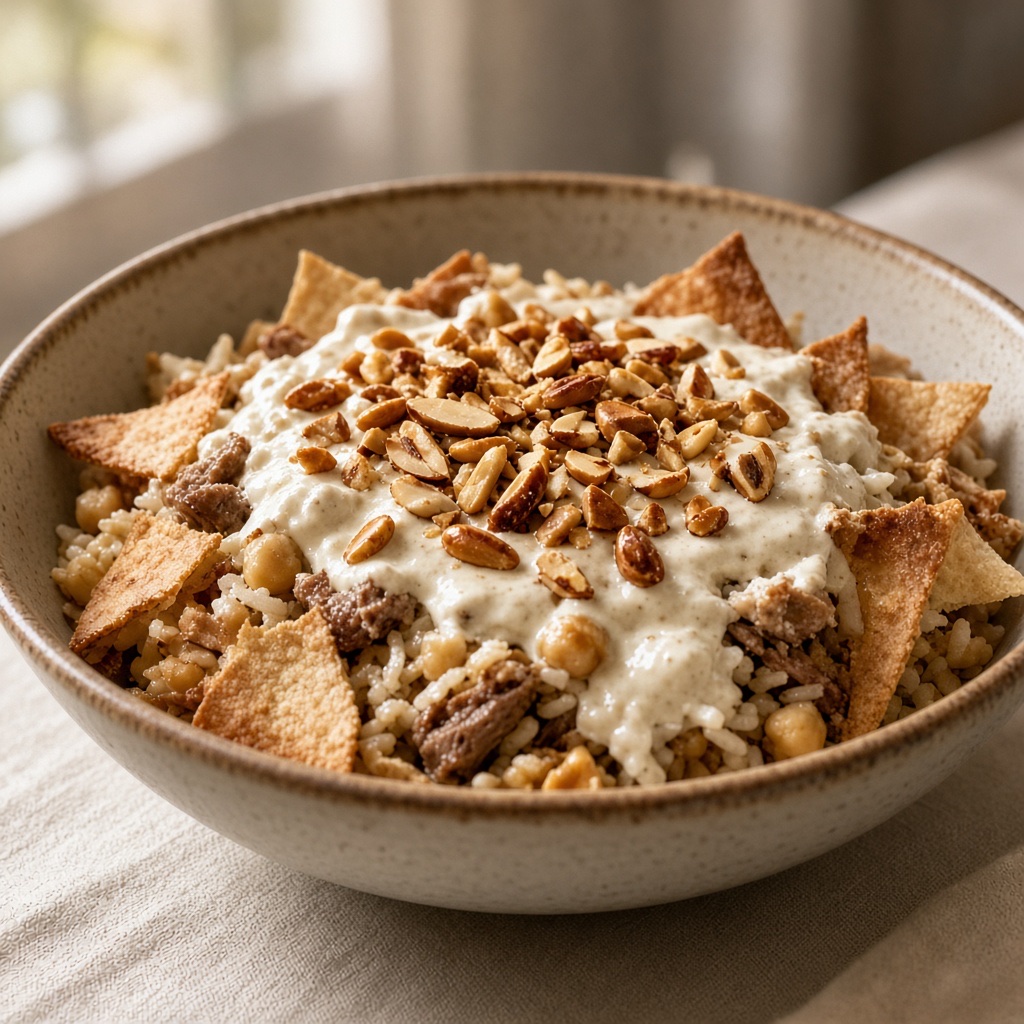
Layers of toasted pita, rice, garlic-vinegar broth and meat — Egyptian celebration fatteh, not the Levantine yoghurt one.
Recipe by I Want Some Food · Reviewed by the editorial kitchen. Native name preserved: فتة.
0 people cooked this in the public kitchen yet. Kitchen-tested by I Want Some Food. Not a purchased rating.
- Prep
- 20 min
- Cook
- 1 hr 30 min
- Rest
- None
- Total
- 1 hr 50 min
- Difficulty
- Medium
- Spice
- No chilli
- Cost
- A bit special$16–28 USD · indicative, not a store price
About
Egyptian fatteh (fattah) for feasts is toasted or fried bread, rice, a garlic-vinegar meat broth poured over so the bread soaks, and chunks of lamb or beef. Some tables add tomato sauce. It is a construction, not a stew you stir. Levantine fatteh with yoghurt and chickpeas is a cousin with a different accent. Toast or fry pieces of stale pita until they are crisp. Cook rice separately. Make a garlic-vinegar broth from the lamb or beef you have simmered, tasting for a sharp, savoury pour. Layer bread, rice, and meat, then pour the hot broth at the table so the bread soaks at the edges and stays crisp in spots. Some households add a tomato sauce layer; some keep it pale. It is a construction you assemble, not a stew you stir. Serve at once. If everything is uniformly soggy, you poured too early or used too much liquid. Yoghurt appears in Levantine cousins; this Cairo feast plate is about meat, garlic, vinegar and bread. Crisp the bread in the oven with a little ghee or oil if you do not want to fry. The garlic-vinegar mixture should taste too sharp in the cup; it will hit starch and meat and calm down. Assemble in a wide dish so you get edge pieces. Spoon from the side, not the soggy middle, if you are greedy in the right way.
Ingredients
Scaling multiplies the written quantities. Baking still prefers a scale.
Steps
Step 1
Simmer lamb in salted water with a few garlic cloves 75 minutes until tender. Keep the broth.
75 minStep 2
Cook rice. Toast or fry the bread until crisp. Keep warm.
20 minStep 3
Sizzle remaining garlic in butter, add vinegar, cumin and a ladle of broth — it will smell sharp. Layer bread, rice, meat. Pour garlic-vinegar broth over so the bread soaks at the edges and stays crisp in the middle.
8 min
Adapt this recipe
The canonical recipe stays intact. Personal versions are labelled. Serving changes are maths, not AI.
Adaptations · 0 / 15 used. Resets 10 October.
Substitutions
Lamb → Beef chuck
Same method, longer simmer if needed.
Tips
- A tomato-garlic sauce on top is a common Cairo extra.
- Chicken fatteh is a lighter household version.
History & culture
Eid and family gatherings. The pour is the theatre. Everyone wants the soggy-crisp bread at the edge. Eid tables and family gatherings in Egypt treat fattah as theatre: the pour, the steam, the fight for the corner where bread is both soaked and crisp. It is feast food, not a Tuesday. Levantine fatteh with yoghurt, chickpeas and pine nuts is a relative with a different accent; mixing the two in one recipe muddles both. At home you can scale it down to a single tray. It is eaten with spoons and bread, among people who already know who sits where. Leftovers are awkward because the architecture collapses. Make what you will finish. The dish is generous on purpose. Relatives compare pours the way other families compare gravies. It is not a dish you portion politely into individual ramekins unless you have already lost the argument. Diaspora Eid tables keep it even when the lamb is supermarket and the bread is whatever pita the shop had. The construction still reads as a feast.
Fatteh means crumbs — stale bread made into a meal. The meat-and-vinegar Cairo version is a feast layering. Fatteh means crumbs: stale bread turned back into a meal, a logic found across the Levant and Egypt wherever bread is daily. The Cairo feast layering with meat and a garlic-vinegar broth is a celebration version of that thrift. Vinegar-garlic sauces have long Egyptian and Levantine company. Rice in the stack marks a later, fuller feast. Ottoman-era and nineteenth-century urban cookery likely shaped the named party dish more than any pharaonic fantasy. Levantine yoghurt fatteh and Egyptian meat fatteh split as regional dialects. There is no need to pick a single inventor. Stale bread plus a pour is the historical engine; the feast garnish is the rest. Crumb-and-pour dishes exist wherever bread stales faster than pride. Egypt's feast version with meat broth and vinegar-garlic is a specific urban and family dialect of that wider idea. Trying to date it to pharaonic kitchens is a tourist reflex. Dating it to bread, feasts, and a sour pour is enough and more accurate.
Regional variation
Provenance: Editorial adaptation.
Questions about this recipe
Answers taken from this dish's times, amounts, swaps and tips — not a chatbot.
How long does Fatteh take?
1 hr 50 min all in — 20 min prep, 1 hr 30 min cook. Cook and rest follow the method. Leftover storage and optional extra waits are not included.
How many does it serve?
The recipe is written for 6 people. Scale the ingredient list on the page if you are cooking for a different number.
How hard is it?
Medium.
How spicy is it?
No chilli.
What allergens should I watch?
This recipe is labelled for Wheat. Labels are informational — check the packets in your kitchen. This is not medical advice.
Does it fit a diet?
The published recipe is labelled Dairy-free.
What does it cost to cook?
A bit special — about $16–28 USD, as a grocery budget for this recipe, not a restaurant price.
What equipment do I need?
Dutch oven, Oven.
How much salt do I put in?
The recipe lists Salt at 2 tsp.
How much vinegar?
4 tbsp of Vinegar.
What can I use instead?
Lamb → Beef chuck. Same method, longer simmer if needed.
Any tips from this recipe?
A tomato-garlic sauce on top is a common Cairo extra. Chicken fatteh is a lighter household version.
Can I use an air fryer?
This method is not written for an air fryer. The core technique on the page still applies.
Similar dishes
Checking your allergy settings…