


Jjamppong
짬뽕
A Korean-Chinese seafood noodle soup so red and briny it fogs your glasses.
Recipe by I Want Some Food · Reviewed by the editorial kitchen. Native name preserved: 짬뽕.
0 people cooked this in the public kitchen yet. Kitchen-tested by I Want Some Food. Not a purchased rating.
- Prep
- 20 min
- Cook
- 25 min
- Rest
- None
- Total
- 45 min
- Difficulty
- Medium
- Spice
- Hot
- Cost
- Weeknight budget$8–16 USD · indicative, not a store price
About
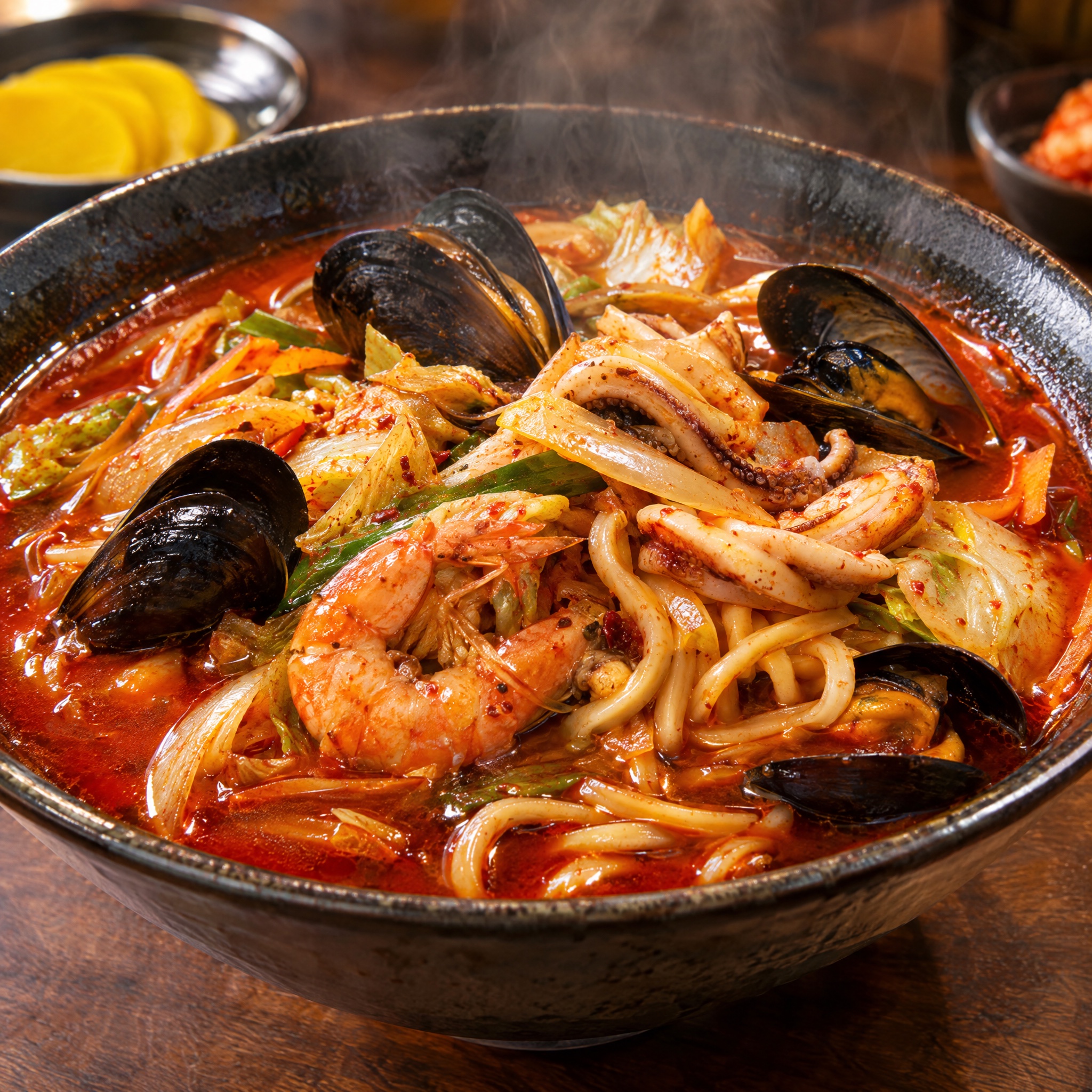
Jjamppong is wheat noodles in a gochugaru-and-seafood broth, with squid, prawns and a pile of cabbage. It is a Korean-Chinese restaurant dish, not a home grandmother's Tuesday — and it is still one of the bowls people search for. The broth should taste of the sea and chilli oil, not just heat. Stir-fry cabbage, onion and seafood hard in chilli oil before the stock so the broth tastes of the wok, not of boiled water plus powder. Cook the wheat noodles separately and combine in the bowl. Done is an orange-red soup, squid and prawns just cooked, vegetables still with a little bite. If the seafood is rubber, it went in too early; gochugaru should bloom in oil; raw flakes on top are a different heat.
Ingredients
- Wheat noodles300 g
- Squid, scored, sliced150 g
- Prawn150 g
- Pork, thin slices (optional)80 g
- Napa cabbage, chunked200 g
- Onion, sliced1
- Zucchini, half-moons½
- Carrot, julienned½
- Garlic5 clove
- Ginger4.9 ml
- Gochugaru30 ml
- Soy sauce30 ml
- Neutral oil30 ml
- Water, or anchovy-kelp stock800 ml
- Dashima (optional)5 g
Scaling multiplies the written quantities. Baking still prefers a scale.
Steps
Step 1
Boil noodles until just flexible. Drain. Keep them waiting, not sitting in water.
6 minStep 2
In a wok, fry garlic, ginger, gochugaru and oil 30 seconds until the chilli smells sweet, not burnt. Add pork if using, then onion, cabbage, carrot and zucchini. Toss 2 minutes.
4 minStep 3
Add stock and soy. Boil hard 5 minutes. Add squid and prawns and cook just until they turn, 2–3 minutes.
8 minTip: Overcooked squid is rubber. Pull the pot when they curl.
Step 4
Divide noodles into bowls, ladle the roaring broth over, spring onion. Eat immediately.
Adapt this recipe
The canonical recipe stays intact. Personal versions are labelled. Serving changes are maths, not AI.
Adaptations · 0 / 15 used. Resets 10 October.
Substitutions
Squid and prawns → A bag of mixed frozen seafood
Thaw and pat dry first so the broth does not go cloudy-watery.
Tips
- Mussels instead of prawns is a shop version.
- No seafood? It is a different soup. Still red. Not jjamppong.
History & culture
Served next to jajangmyeon in the same shops. Half-and-half (banban) is a real order. At home a wide pot and whatever seafood is in the freezer still works. Korean-Chinese restaurants still print it next to jajangmyeon; banban (half and half) is a standard order. Hangover tables order the spicier pot. Home versions use freezer seafood and a wide casserole and do not pretend to be a junggukjip. It is louder than most Chinese seafood noodle soups on purpose.
Chinese immigrant kitchens in Korea built this spicy seafood noodle. It is Korean now in the way jajangmyeon is Korean. This spicy seafood noodle was built in Chinese immigrant kitchens in Korea in the twentieth century. Chanpon comparisons are sometimes made and remain an argument, not a proof. It is Korean-Chinese restaurant food in the same way jajangmyeon is — a local category, not a home grandmother's Tuesday. Date it as shop cooking.
Regional variation
Provenance: Editorial adaptation.
Questions about this recipe
Answers taken from this dish's times, amounts, swaps and tips — not a chatbot.
How long does Jjamppong take?
45 min all in — 20 min prep, 25 min cook. Cook and rest follow the method. Leftover storage and optional extra waits are not included.
How many does it serve?
The recipe is written for 2 bowls. Scale the ingredient list on the page if you are cooking for a different number.
How hard is it?
Medium.
How spicy is it?
Hot.
What allergens should I watch?
This recipe is labelled for Wheat, Shellfish, Fish, Soy. Labels are informational — check the packets in your kitchen. This is not medical advice.
Does it fit a diet?
The published recipe is labelled Dairy-free, Nut-free.
What does it cost to cook?
Weeknight budget — about $8–16 USD, as a grocery budget for this recipe, not a restaurant price.
What equipment do I need?
Wok, Saucepan.
How much salt do I put in?
This recipe does not list salt as its own ingredient. Saltiness comes from Soy sauce — 2 tbsp. Taste at the end rather than adding a number we did not write.
How much gochugaru?
2 tbsp of Gochugaru.
How much soy sauce?
2 tbsp of Soy sauce.
What can I use instead?
Squid and prawns → A bag of mixed frozen seafood. Thaw and pat dry first so the broth does not go cloudy-watery.
Any tips from this recipe?
Mussels instead of prawns is a shop version. No seafood? It is a different soup. Still red. Not jjamppong.
Can I use an air fryer?
This method is not written for an air fryer. The core technique on the page still applies.
Similar dishes
Checking your allergy settings…