


Jajangmyeon
짜장면
Thick wheat noodles under a black-bean gravy of pork and fried chunjang — Korea's Chinese-restaurant hug.
Recipe by I Want Some Food · Reviewed by the editorial kitchen. Native name preserved: 짜장면.
0 people cooked this in the public kitchen yet. Kitchen-tested by I Want Some Food. Not a purchased rating.
- Prep
- 20 min
- Cook
- 25 min
- Rest
- None
- Total
- 45 min
- Difficulty
- Medium
- Spice
- No chilli
- Cost
- Weeknight budget$8–16 USD · indicative, not a store price
About
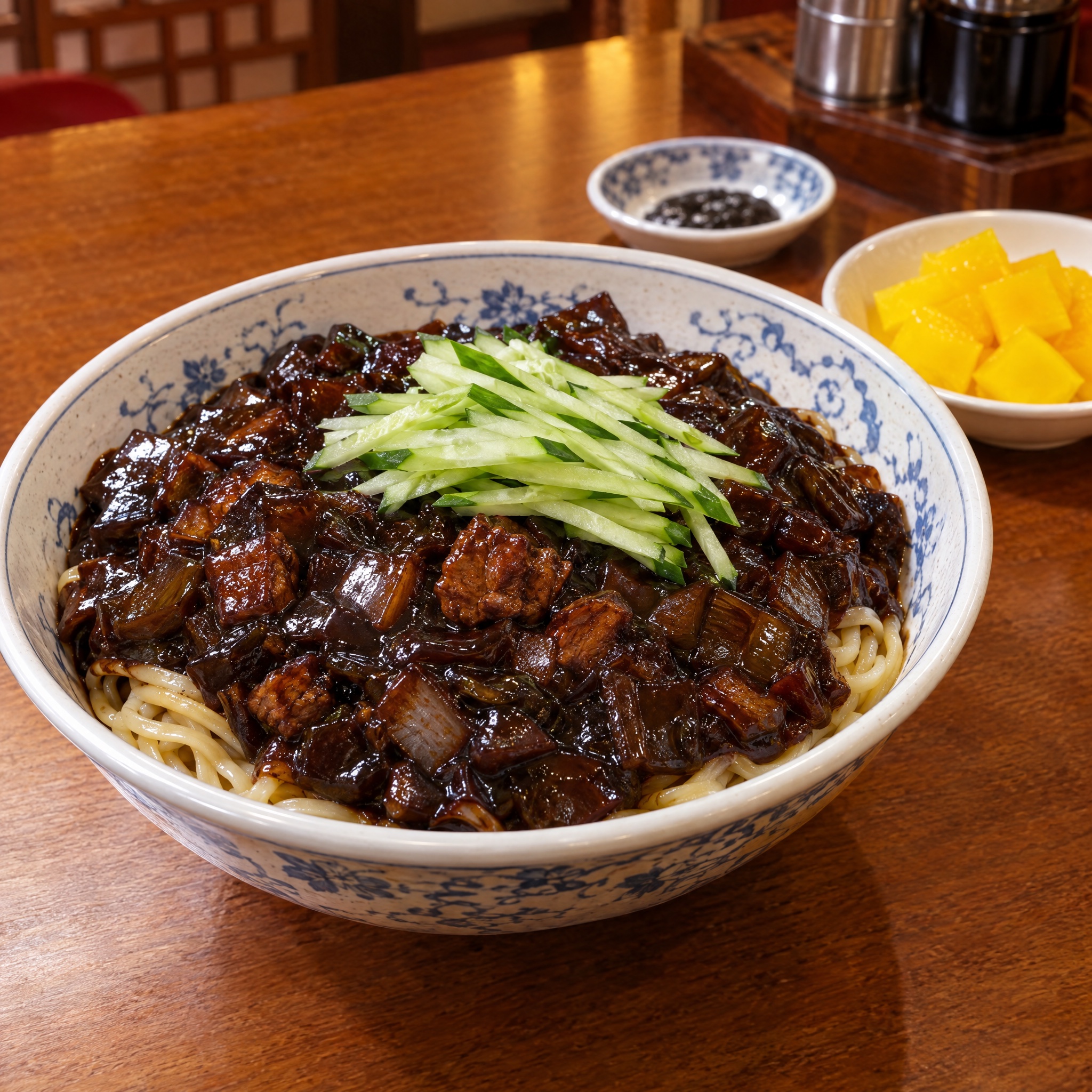
Jajangmyeon is Korean-Chinese, not a Beijing import on a plane. You fry chunjang in oil until the raw bitterness cooks off, then build a gravy with pork, onion and zucchini, and pour it over thick noodles. A little sugar is correct. It should be glossy and clingy, not watery soy. Fry chunjang in plenty of oil until the raw, bitter smell turns nutty and the oil goes dark — under-fried paste tastes dusty. Onions should collapse into the gravy; zucchini keeps a little bite. A pinch of sugar is correct. Done is a glossy mound that sits on thick noodles instead of a watery soy lake; water-starch at the end should thicken, not turn the sauce to jelly.
Ingredients
- Wheat noodles400 g
- Chunjang74 ml
- Pork, diced shoulder250 g
- Onion, chunked2
- Zucchini, chunked1 small
- Potato, diced (optional)1 small
- Napa cabbage (optional)100 g
- Neutral oil44 ml
- Sugar15 ml
- Potato or corn starch, mixed with 3 tbsp water15 ml
- Water400 ml
- Cucumber, julienned, to finish¼
Scaling multiplies the written quantities. Baking still prefers a scale.
Steps
Step 1
Fry chunjang in 2 tbsp oil over medium heat 2–3 minutes, stirring, until it smells roasted and a little sweet. Scrape into a bowl.
3 minTip: This step is the difference between bitter paste and jajang.
Step 2
In the same pan, cook pork, then onion, zucchini and potato until they take colour. Return the paste, add water and sugar. Simmer 10 minutes.
12 minStep 3
Thicken with starch slurry until the gravy mounds on a spoon. Boil noodles, drain well, sauce generously, top with cucumber.
Adapt this recipe
The canonical recipe stays intact. Personal versions are labelled. Serving changes are maths, not AI.
Adaptations · 0 / 15 used. Resets 10 October.
Substitutions
Pork → Diced mushrooms
Use a little more oil when frying the paste.
Tips
- A fried egg on top is a home flourish.
- Jaengban-jajang is the same gravy over a share platter of noodles.
History & culture
Black day (April 14) and 'I can't be bothered to cook' both belong to this bowl. Delivery culture in Korea is partly a jajangmyeon story. April's Black Day and any 'I am not cooking' night both belong to delivery motorbikes. Children treat it as a birthday-adjacent treat in some houses. Moving-day and exam-day orders are ordinary. Junggukjip (Korean-Chinese rooms) still sell it next to jjamppong; half-and-half is a real order, not a tourist invention.
Shandong-style noodles met Korean tastes in Incheon's Chinatown and then the whole peninsula. The sweet-dark gravy is local. Zhajiangmian from Shandong ports was rewritten in Incheon's Chinese quarter in the early twentieth century, then spread down every high street. The sweet, glossy-dark gravy is a local rewrite, not a Beijing copy flown in. Motorbike delivery in the late twentieth century made it infrastructure. We date it as Korean-Chinese restaurant food, which is a Korean category.
Regional variation
Provenance: Editorial adaptation.
Questions about this recipe
Answers taken from this dish's times, amounts, swaps and tips — not a chatbot.
How long does Jajangmyeon take?
45 min all in — 20 min prep, 25 min cook. Cook and rest follow the method. Leftover storage and optional extra waits are not included.
How many does it serve?
The recipe is written for 3 bowls. Scale the ingredient list on the page if you are cooking for a different number.
How hard is it?
Medium.
How spicy is it?
No chilli.
What allergens should I watch?
This recipe is labelled for Wheat, Soy. Labels are informational — check the packets in your kitchen. This is not medical advice.
Does it fit a diet?
The published recipe is labelled Dairy-free, Nut-free.
What does it cost to cook?
Weeknight budget — about $8–16 USD, as a grocery budget for this recipe, not a restaurant price.
What equipment do I need?
Wok, Saucepan.
How much salt do I put in?
This recipe does not list a salt amount. We will not invent one.
How much sugar?
1 tbsp of Sugar.
What can I use instead?
Pork → Diced mushrooms. Use a little more oil when frying the paste.
Any tips from this recipe?
A fried egg on top is a home flourish. Jaengban-jajang is the same gravy over a share platter of noodles.
Can I use an air fryer?
This method is not written for an air fryer. The core technique on the page still applies.
Similar dishes
Checking your allergy settings…