


Potjiekos
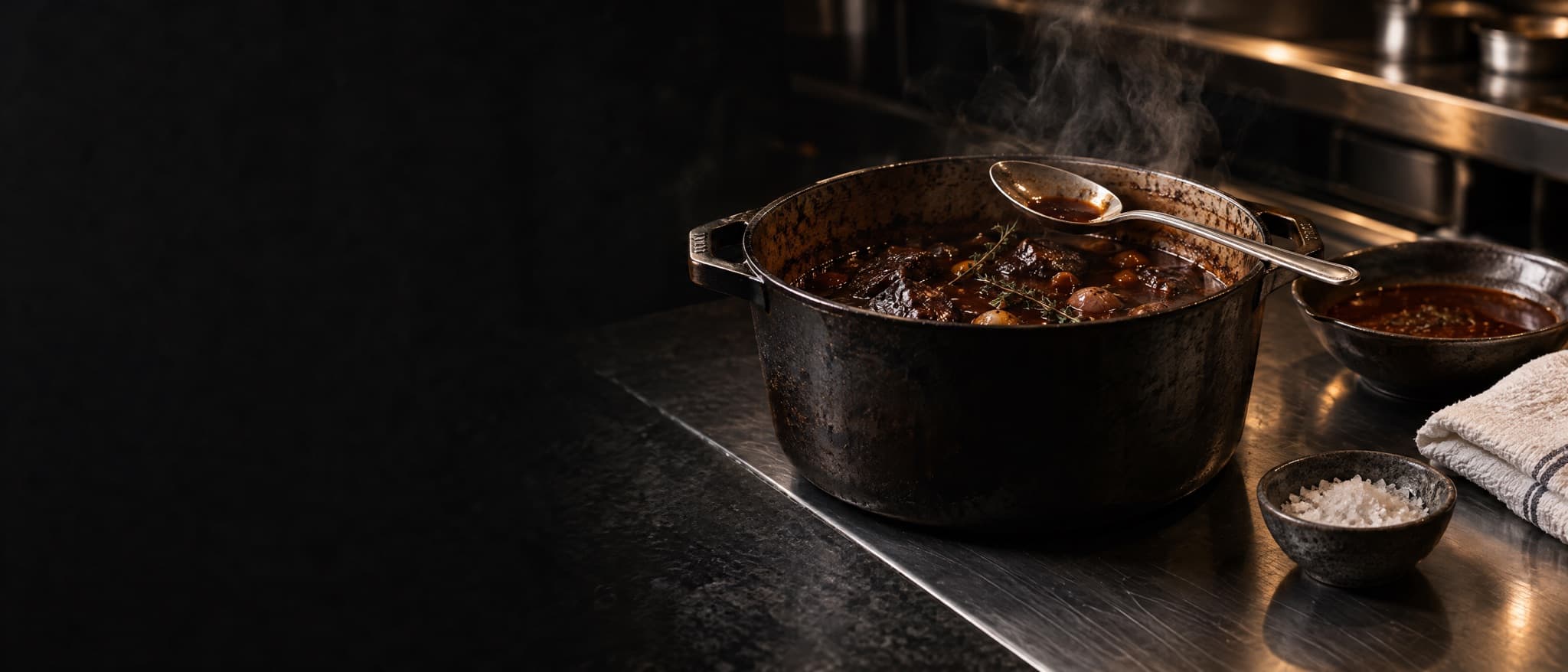
Slow lamb and vegetable stew built in layers in a cast-iron pot and left alone for hours, South African camp style.
Recipe by I Want Some Food · Reviewed by the editorial kitchen.
- Prep
- 30 min
- Cook
- 3 hr
- Rest
- None
- Total
- 3 hr 30 min
- Difficulty
- Easy
- Spice
- No chilli
- Cost
- A bit special$16–28 USD · indicative, not a store price

About
Potjiekos means 'small-pot food': a stew cooked in a three-legged cast-iron pot over coals. Meat is browned in the base, onions softened, then vegetables are stacked in layers according to how long they take, with the quickest on top. Stock and a little wine go in, the lid goes on, and the pot is not stirred for two or three hours. The layers steam in each other's juices and come apart at the table. This version is lamb with potato, carrot, sweet potato, butternut and green beans, cooked in a Dutch oven on a hob or in the oven, since most of us do not have a fire going.
What you'll need
16 ingredients. Tap each one once it's out on the bench.
Ingredients
Choose one
Lamb, neck, shoulder or knuckle, bone-in, cut into chunks1 kg- Onion, sliced2 large
- Garlic, sliced3 clove
- Wheat flour, for dusting the meat30 ml
- Neutral oil44 ml
- Red wine150 ml
- Beef stock, hot300 ml
- Thyme, dried4.9 ml
- Potato, peeled, halved3 medium
- Carrot, thick rounds3 medium
- Sweet potato, peeled, thick chunks1 large
- Butternut squash, peeled, large cubes300 g
- Green beans, topped150 g
- Salt7.4 ml
- Black pepper4.9 ml
Scaling multiplies the written quantities. Baking still prefers a scale.
Steps
Step 1
Season the lamb with salt and pepper and dust with flour. Heat the oil in a heavy lidded pot and brown the meat in batches until dark at the edges. Set aside.
15 min
Step 2
Lower the heat. Soften the onion and garlic in the fat for 8 minutes, scraping up the brown bits. Return the meat with the bay and thyme.
10 min
Step 3
Pour in the wine and let it bubble for 2 minutes, then add the hot stock. The liquid should come no more than halfway up the meat.
3 min
Tip: A potjie makes its own liquid from the vegetables. Too much stock at the start gives you soup.
Step 4
Layer the vegetables on top of the meat without stirring: potatoes first, then carrots, then sweet potato and butternut, then the green beans. Season each layer lightly with salt.
5 min
Step 5
Put the lid on tightly. Cook at the gentlest simmer on the hob, or in a 150 °C oven, for 2.5 to 3 hours. Do not stir and do not lift the lid more than once to check there is still liquid at the bottom.
165 min150°C
Watch: Lifting the lid lets the steam out and the top layers go dry. Trust it.
Step 6
Check the meat is falling from the bone and the potatoes are soft. Taste the liquid for salt. Serve straight from the pot, spooning down through the layers, with rice or pap.
5 min
Nutrition
Per serving · estimate
- Calories
- 1093 kcal
- Protein
- 48.6 g
- Carbs
- 41 g
- Fat
- 82.2 g
- Saturated fat
- 41.2 g
- Fibre
- 7.4 g
- Sugar
- 7.2 g
- Sodium
- 945 mg
Calculated from canonical ingredient data (USDA FoodData Central averages and equivalent published tables). Estimates only.
Allergens
Informational only. Not a medical guarantee. Cross-contamination happens in real kitchens.
- Wheat
- Dairy-free
- Nut-free
Adapt this recipe
The original recipe stays as it is. Personal versions are labelled. Serving changes are simple maths.
Adaptations · 0 / 15 used. Resets 12 November.
Substitutions
Red wine → An extra 150 ml stock or a bottle of beer
Beer potjie is its own tradition. Use a dark lager.
Tips
- Over coals, keep a small fire of a few briquettes under the pot and replace them as they die. The pot should barely murmur.
- A handful of dried apricots or a glug of sherry in the liquid is common in Cape versions and worth trying.
- Chicken potjie is quicker: thighs on the bone, 90 minutes total.
History & culture
A potjie is an event, not a recipe. Friends stand around the pot with drinks for the afternoon, arguing about whether to lift the lid. It is weekend and camping food across South Africa and Namibia, with competitions taken seriously. Rice or pap and a glass of red wine are the standard sides.
The cast-iron pot came to the Cape with the Dutch in the seventeenth century and travelled inland with Voortrekker ox-wagons in the 1830s, where game and vegetables were cooked slowly over wagon-train fires. The layered, no-stir method is the direct descendant of that necessity.
Regional variation — Cooked in a Dutch oven on the hob or in a low oven rather than in a three-legged potjie over coals. The layering and the no-stir rule are kept.
Provenance: Editorial adaptation.
Questions about this recipe
Answers taken from this dish's times, amounts, swaps and tips.
How long does Potjiekos take?
3 hr 30 min all in — 30 min prep, 3 hr cook. Cook and rest follow the method. Leftover storage and optional extra waits are not included.
How many does it serve?
The recipe is written for 6 people. Scale the ingredient list on the page if you are cooking for a different number.
How hard is it?
Easy.
How spicy is it?
No chilli.
What allergens should I watch?
This recipe is labelled for Wheat. Labels are informational — check the packets in your kitchen. This is not medical advice.
Does it fit a diet?
The published recipe is labelled Dairy-free, Nut-free.
7 more questionsFewer questions
What does it cost to cook?
A bit special — about $16–28 USD, as a grocery budget for this recipe, not a restaurant price.
What equipment do I need?
Dutch oven, Chef's knife, Cutting board.
How much salt do I put in?
The recipe lists Salt at 1½ tsp.
What can I use instead?
Red wine → An extra 150 ml stock or a bottle of beer. Beer potjie is its own tradition. Use a dark lager.
What should I watch for?
Lifting the lid lets the steam out and the top layers go dry. Trust it.
Any tips from this recipe?
Over coals, keep a small fire of a few briquettes under the pot and replace them as they die. The pot should barely murmur. A handful of dried apricots or a glug of sherry in the liquid is common in Cape versions and worth trying. Chicken potjie is quicker: thighs on the bone, 90 minutes total.
Can I use an air fryer?
This method is not written for an air fryer. The core technique on the page still applies.
Similar dishes

Seswaa
Seswaa from Botswana.
Easy

Beef pumpkin Stew
Beef pumpkin Stew from Botswana.
A bit of work

Irish stew
stobhach
Lamb, potato, onion — a pale pot, no wine, no bouquet garni performance.
Easy

Lancashire hotpot
Lamb and onion under a lid of overlapping potatoes — a northern oven pot, no pastry, no apology.
Easy